


.svg)
.svg)
.svg)
.svg)



.svg)


.svg)
.svg)


Whatfix is often praised, but not without its fair share of criticism.
It promises to tackle a wide range of product adoption and onboarding challenges, but does it truly deliver? More importantly, are there better tools out there that might suit your needs more effectively?
In this article, we’ll explore:
- What Whatfix does (and where it falls short)
- 11 powerful alternatives that might be a better fit, depending on your goals
Let’s dive in.
TL;DR
- Whatfix is good for multi-platform app support and analytics, but is expensive, not very intuitive, and end-products (like surveys) can feel outdated.
- UserGuiding is good for overall user experience and communication both in-app and off-app, but it lacks mobile support.
- Product Fruits is good for getting started with onboarding as a budget-friendly solution; however, it lacks advanced features like analytics and multi-platform support.
- Appcues is good for A/B testing, but it’s expensive and lacks certain behavioral analytics capabilities.
- Chameleon is good for embedded modals and CMD+K search, but lacks multi-platform support.
- Userflow is good for creating in-app experiences with ease, but its analytics features are limited.
- Userpilot is good for both in-app and mobile experiences, but it’s expensive and comes with a learning curve.
- Pendo is good for product planning and UX management, but has a steep learning curve and limited customer support.
- WalkMe is good for employee onboarding and productivity, but it requires coding knowledge and is difficult to implement and maintain.
- Intercom is good for AI agents and its knowledge base, but its in-app experience features feel disjointed and lack depth.
- Intro.js is good for simple user onboarding through code-based product tours and interactive hints.
- Shepherd is good for user onboarding through building simple product tours and interactive elements like tooltips and modals, but it lacks the features to be a complete digital adoption platform.
What is Whatfix?
- G2 Score: 4.6⭐/5 (375 reviews)
Whatfix is a digital adoption and product analytics platform that helps you guide your users contextually, reduce support costs –and loads–, improve user productivity and feature discovery.
Whatfix offers 3 solutions:
- Digital Adoption Platform (DAP)
- Product Analytics
- Mirror

DAP and Product Analytics are pretty self-explanatory.
With DAP, you get in-app experience features like interactive guides, tooltips, checklists, and micro surveys, as well as engagement analytics/reporting for these materials. Whatfix DAP helps you with in-app guidance, support, and engagement.
Product Analytics offers detailed user behavior and engagement analytics, along with no-code event tracking, AI-powered conversational analytics, Funnels, and Journeys. So, Analytics helps you understand user behavior and journey.
Mirror, on the other hand, is Whatfix’s solution that enables you to create interactive replicas (sandbox environments) to use for hands-on training or user testing. The aim is to allow the end-user to learn by interacting, but not risk any live software usage. Mirror can be used for employee training, as well as customer training.
It also comes with analytics capabilities that capture user behavior and engagement data to showcase the success of your training.
One of Whatfix’s strengths is its AI capability that automatically scans guides to detect broken links when UI changes occur. This is especially valuable for teams working on products with frequent interface updates.
Whatfix Pricing
Whatfix doesn’t have transparent pricing, so we don’t know exactly how much a specific plan or solution costs. But we do know how their pricing structure works, at least.
There are 3 products, as we’ve already mentioned: DAP, Product Analytics, and Mirror.
If you’re going with DAP, the first step is choosing the platform where you’ll use the product. You can pick from Web & Desktop, Mobile, or OS (Windows and Mac operating systems).
For DAP on Web & Desktop, there are three plan options: Standard, Premium, and Enterprise. If you plan to use it on Mobile or OS, there’s just one available plan, which is Standard. All Web & Desktop DAP plans come with Standard Product Analytics by default. If you want to upgrade to Premium or Enterprise Analytics, you’ll need to purchase the Product Analytics tool separately.
Product Analytics itself has three plans for Web & Desktop apps: Standard, Premium, and Enterprise. You cannot choose a platform here, so you just pick the plan that fits your needs.
Mirror, on the other hand, is the most limited of the three. It only supports web apps and comes in a single plan: Standard.
So, to sum it up, Whatfix pricing depends on a few things. It’s based on how many of their products you need, which platforms you’ll use DAP on, the feature set you choose (which means your plan), and user license fees.
User license fees are calculated based on your MAU or, if you’re using Whatfix for internal business needs, the number of employees who have access to the product.
➕There are also several add-on options, such as:
- On-Premise Authoring
- White Labeling
- 24/7 Customer Support (All plans include 24/5 support, normally)
- Digital Adoption Assistant (Like a dedicated customer success specialist)
- Digital Adoption Program Manager (Like a dedicated project manager)
What are the weaknesses of Whatfix?
With three different solutions, Whatfix might seem like the answer to all your problems (as long as you’ve got the resources to buy all three for however many employees and/or customers you have, across however many platforms they're active on...).
But before you start doing the math and planning how many plans you need to stack up, let’s talk about the not-so-great sides of Whatfix 👎🏻
- Lacking Key Adoption Features: Whatfix doesn’t include built-in tools like knowledge bases, resource centers, product update pages, or AI assistants for end users, though these are common features in many modern adoption platforms.
- Overwhelming and Complex Analytics: While Whatfix provides powerful analytics for funnels, trends, journeys, and actionable insights, the setup process can be complex. Without proper configuration, dashboards may display inaccurate or incomplete data.
- Limited Survey Capabilities: Survey customization is somewhat limited, especially when it comes to logic and design flexibility. The end results may also feel a bit dated compared to more modern interfaces.
- Outdated and Bulky UI/UX: Some parts of the platform, like the feature builders, feel outdated and heavy to navigate. This can lead to a less intuitive experience for users building and managing content.
- Steep Learning Curve: From content creation elements like separators to the analytics setup, the platform often isn’t as intuitive as it could be. In some cases, it may require support from IT or more technical teams, which limits its ability to be a fully standalone tool for non-technical users.
- Complex Pricing: Whatfix’s pricing tiers can scale up quickly and may be difficult to estimate accurately. It’s not always clear how pricing will evolve as your needs grow, which can make planning for the future more challenging.
11 Best Alternatives to Whatfix (Free & Paid)
#1 Whatfix vs. UserGuiding
- G2 Score: 4.7⭐/5 (632 reviews)
UserGuiding is an all-in-one, no-code product adoption platform that helps you deliver engaging, personalized self-serve experiences for your users. You can use UserGuiding to onboard new customers (or employees), announce new features, provide automated in-app support, conduct user research, gather feedback, and track as well as improve feature engagement.
Here is what you get with UserGuiding, in terms of features and functionalities:
- Product tours
- Onboarding checklists
- Hotspots and tooltips
- Announcement modals (banners, slideouts, pop-ups, etc.)
- NPS and custom in-app surveys
- AI assistant
- Resource center (in-app)
- Knowledge base (standalone)
- Product updates (standalone)
- Segmentation
- Analytics

As Whatfix and UserGuiding cater to similar audiences (product teams, customer success, HR enablement, etc.), they offer many overlapping features. However, they differ significantly in their core focus, user experience coverage, and ease of use.
UserGuiding provides a balanced approach to both in-app and off-app user experiences. It includes a robust set of in-app tools like guides, checklists, and NPS surveys, alongside standalone modules such as a knowledge base and product updates page. This makes it easier to engage users both inside the product and across external touchpoints.
Whatfix focuses more heavily on analytics and experiential learning, especially with its Mirror solution, which allows users to learn by doing in sandbox environments. And when looking at the DAP product alone, we see that Whatfix emphasizes multi-platform support, covering web, desktop, mobile, and OS, rather than expanding the breadth of in-app/off-app capabilities.
Here’s how these 2 tools’ features compare side by side 👇🏻
Features matter, but factors like integrations, security, compliance, and pricing also play a big role. Here’s how Whatfix and UserGuiding compare on those fronts:
UserGuiding Pricing
UserGuiding has 3 paid plans.
These plans are Starter, Growth, and Enterprise, all based on MAU (Monthly Active Users).
The Starter plan starts at $249/month (billed yearly) for up to 2,000 MAU.
The Growth plan begins at $499/month (billed yearly) for up to 2,000 MAU.
Monthly billing is also available. While yearly contracts save you 30% over the year, if you prefer monthly payments, UserGuiding has you covered. With monthly billing, prices for up to 2,000 MAU start at:
- Starter: $349/month
- Growth: $699/month
The Enterprise plan has custom pricing.
UserGuiding stands out for how much it includes, even in its lower-tier plans.
The Starter plan comes with access to most core/ basic features, like guides, hotspots, surveys, checklists, a resource center, and basic analytics, which makes it a solid choice for small and midsize businesses (SMB).
However, it does come with usage caps (e.g., limited number of active guides, surveys, and checklists) and lacks advanced features like custom CSS, A/B testing, goal tracking, and localization.
The Growth plan lifts many of these restrictions and adds more advanced functionality, offering a better fit for growing teams that need deeper customization and optimization tools.
Starter and Growth plans come with 50 free AI assistant resolutions, as well. Other than AI resolutions, all three plans include features such as Lighthouse AI, AI insights andsurveys and more.
📝 Here’s what UserGuiding customers say about the platform:
#2 Whatfix vs. Product Fruits
- G2 Score: 4.7⭐/5 (137 reviews)
Product Fruits is a user onboarding tool that offers features and capabilities for in-app guidance, feature discovery, and user retention. These features include:
- Tours and hints (tooltips and hotspots)
- Onboarding checklists
- NPS and surveys
- Announcements (banners, pop-ups, and newsfeed)
- Life ring button (resource center)
- Knowledge base
- Feedback widget (for bug reports and user feedback)
- AI writer
- Segmentation
- Event tracking
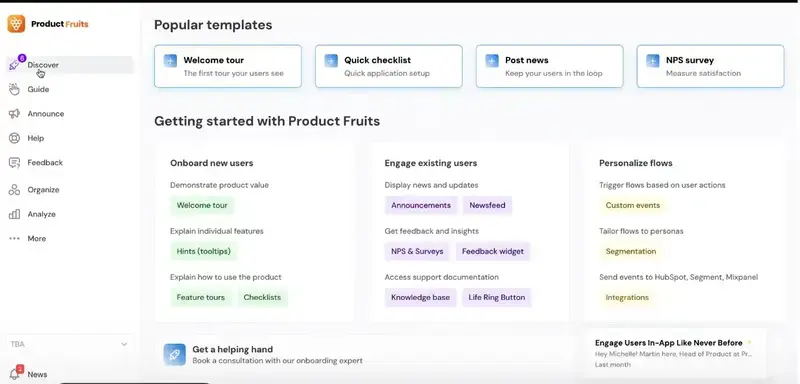
Product Fruits’ AI Writer should not be confused with an AI assistant. The AI writer helps you write, optimize, or shorten microcopy for your flow materials, for example, interactive guide steps or tooltips. So it interacts with you, not the end user.
One another AI capability is the platform’s AI summarizer that lives within the knowledge base, which is more similar to an AI assistant, actually. What the AI summarizer does is provide a short and curated answer to the user’s question. This way, it saves the user time by eliminating the need to read several articles.
This one is for your end users, though it’s not really interactive.
Whatfix Wins at…
- Product Analytics and Reporting: Product Fruits’ analytics capabilities are limited to basic material engagement reports, so if detailed reports are a must for you, Product Fruits might not meet your expectations.
- Multi-platform Support: Product Fruits works only on web-based applications.
Product Fruits Wins at…
- Knowledge Base: Product Fruits allows you to create a standalone knowledge base for your help materials. You can then link it with your Life Ring Button (a.k.a. resource center).
- Usability: Product Fruits has little to no learning curve and is a no-code tool that is easy for non-technical users to set up and maintain.
- Pricing: Product Fruits is on the lower end of the price scale among onboarding tools.
Product Fruits Pricing
Product Fruits has 3 plans: Starter, Pro, and Enterprise.
Similar to UserGuiding’s pricing, Product Fruits bases its plan calculations on MAU and allows you to calculate your probable cost on their pricing page with an MAU slider.
The Starter plan starts at $96/mo (billed yearly) for up to 1,500 MAU. The same plan with the same MAU limits costs $129/mo when it is billed monthly. The Pro plan starts at $149/mo (billed yearly) for up to 1,500 MAU, and $199/mo when it’s billed monthly.
The costs of the plans increase every 1,500 MAU. So, from 1,500 to 3,000 MAU, the Starter plan costs $149/mo and the Pro plan costs $224/mo, both billed yearly.
The Enterprise plan has custom pricing.
In terms of features included in the plans, the platform’s main offerings are included in all plans. So, you get unlimited tours, walkthroughs, UI hints, beacons, and tooltips with all plans. Checklist feature has a cap in the Starter plan, you get 3 of them, but it becomes unlimited in the Pro and Enterprise plans, as well.
Announcements, newsfeeds, resource center, and feedback widgets are included in all plans, too.
The main differences between the feature sets of the plans are the knowledge base, surveys, and the AI writer. The knowledge base in the Starter plan is public; you cannot create a password-protected one for only internal use. While the surveys and the AI writer are not offered within the Starter plan at all.
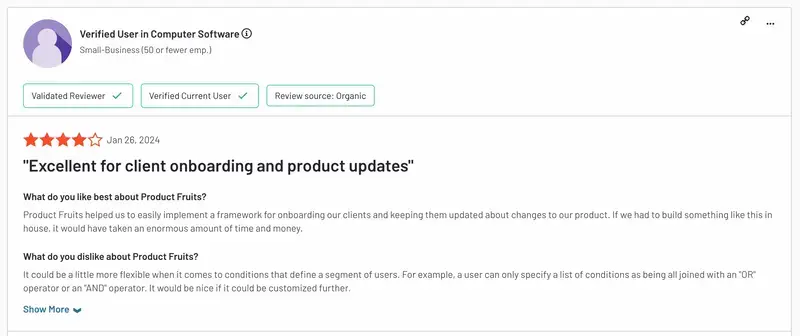
📝 Here’s what Product Fruits customers say about the platform:
#3 Whatfix vs. Appcues
- G2 Score: 4.6⭐/5 (336 reviews)
Appcues is a multi-channel user engagement platform that offers features/capabilities for in-app messaging, feature engagement, and trial conversion. It allows you to map user journeys and automate workflows, as well.
Some of the features/capabilities Appcues offers are:
- Flows (modals, slideouts, and hotspots)
- Tooltips
- In-app Surveys and NPS
- Checklists
- Launchpads (in-app resource center)
- Banners
- Resource Centers
- Segmentation
- Event Tracking
- A/B Testing
- Email Messaging

Like Whatfix, Appcues supports both mobile apps and iFrames. However, not all features, even some basic engagement tools like checklists, are included in its mobile plans.
So, if mobile is a key use case for you, Appcues can be a valid option, but it’s important to compare feature-by-feature with Whatfix or other alternatives before making a decision.
Whatfix Wins at…
- Detailed Analytics: Whatfix offers advanced, granular analytics with features like Funnels, Journeys, Trends, and Cohorts.
- Whatfix AI: Whatfix AI enhances content creation, task automation, and insight generation using natural language.
- Experiential Learning (Mirror): Whatfix’s Mirror feature allows you to create interactive, sandbox environments for hands-on training and user testing.
Appcues Wins at…
- User Interface: Appcues’ UI is cleaner, more modern, and easier to navigate compared to Whatfix’s older, bulkier interface.
- Multi-Channel Communication: Appcues enables you to orchestrate user experiences across multiple channels, including email, in-app messages, mobile, and push notifications.
- Workflow Automation: Appcues now offers user journey mapping, allowing you to automate messaging across various touchpoints.
- A/B Testing: Appcues includes a built-in variation testing feature for optimizing user flows.
Appcues Pricing
Appcues offers three plans: Start, Grow, and Enterprise.
The Start plan begins at $300/month (billed annually) for up to 1,000 MAUs, and the Grow plan starts at $750/month for the same user limit. As your MAUs increase, so do the costs, with noticeable jumps in price for even small increments in MAUs. This makes Appcues one of the pricier options for scaling teams.
And when we say jumps, we mean a price hike every 500 MAUs. The Start plan tacks on $75/month for each extra 500 users, while Grow bumps up by $50/month every 500 MAUs.
On top of that, many essential features like resource centers, NPS surveys, and advanced integrations are either excluded from the Start plan or available only as add-ons. Support and integrations are also limited at the lower tiers.
📝 Here’s what Appcues customers say about the platform:

#4 Whatfix vs Chameleon
- G2 Score: 4.4⭐/5 (293 reviews)
Chameleon is a product adoption platform that helps you improve your in-app engagement and communication through poo-up modals as well as embedded ones.
Here’s what you get with Chameleon:
- Product Tours
- Modals
- Banners
- Embedded Cards
- Tooltips
- Checklists
- Resource Centers
- NPS & Microsurveys
- CMD+K Search

A unique capability Chameleon provides is the CMD+K Search, a centralized in-app search bar that enables users to access relevant support resources, such as help articles, FAQs, or AI-generated summaries, from one location. This streamlines user access to distributed documentation.
Additionally, Chameleon offers a comprehensive and structured onboarding experience, including interactive Arcade demos that demonstrate full feature workflows and showcase how the product can be used effectively.
Whatfix Wins at…
- Multi-platform Support: Chameleon is limited to browser-based web apps, while Whatfix supports web, desktop, mobile apps, and even OS.
- Product Analytics: Chameleon offers engagement analytics for specific features, but lacks broader behavioral insights. Whatfix, in contrast, provides comprehensive product analytics with funnels, journeys, and event tracking.
- Mirror: Chameleon showcases interactive demos during onboarding, but these are built with a third-party tool, not Chameleon itself. Whatfix’s Mirror is a native solution that lets teams create realistic, hands-on training environments without relying on live software.
Chameleon Wins at…
- Usability: Chameleon has a more intuitive UX with an easier implementation and setup, even for non-technical users.
- UI Design: Chameleon has a more user-friendly interface with modern and intuitive feature builders and a product extension.
- CMD+K Search and AI Answers: You can train your AI with your help documentation and incorporate it into your CMD+K Search bar.
- Embedded Modals: Whatfix supports embedded tooltips, but Chameleon offers a broader and more customizable range of embedded experiences. With Chameleon, you can build embedded modals, banners, tooltips, checklists, guide components, and more.
- Pricing: Chameleon has a relatively more transparent pricing modal compared to Whatfix. Plus, it is also more accessible for SMBs.
Chameleon Pricing
Chameleon has 3 paid plans and a free plan.
The free plan, Demos Free, includes unlimited interactive demos and engagement tracking, only.
They also offer their HelpBar for free, which includes CMD+K Search and AI Answers, making it suitable for in-app and automated support use cases.
The paid plans are called Startup, Growth, and Enterprise.
Only the Startup and Growth plans have publicly listed pricing, starting at $279/month and $12,000/year, respectively. Enterprise plan requires custom quotes.
Even at the Startup level, the feature set is comprehensive. It includes tours, tooltips, embeddables, microsurveys, launchers, custom CSS, dynamic personalization, user segmentation, event tracking, and reporting.
The Growth plan either raises feature caps or removes them entirely, for example, unlimited embeddables, microsurveys, and launchers.
A/B testing is available only in the Growth and Enterprise plans.
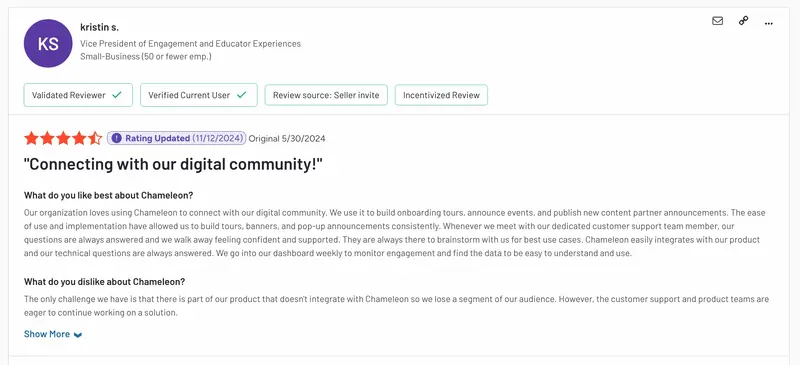
📝 Here’s what Chameleon customers say about the platform:
#5 Whatfix vs. Userflow
- G2 Score: 4.8⭐/5 (106 reviews)
Userflow is a no-code user onboarding tool that helps improve your users’ in-app experience through guides, announcements, and contextual assistance. It focuses on in-product UX and offers features such as:
- Product tours and Interactive Walkthroughs (Flow Builder)
- Checklists
- In-app surveys
- Resource center
- Banners
- Feature announcements
- AI assistant
- Segmentation
- Event tracking

Userflow lets you design user journeys by building out visual flows with elements like tooltips, modals, hotspots, and surveys. These flows are displayed in a diagram format, giving you a clear overview of the full experience. Other components, like resource centers, checklists, and banners, have dedicated builders, as well.
Customization is fairly flexible and user-friendly, although some settings are split between the feature-level controls and the global settings menu. While the UI is mostly intuitive, it may feel slightly overwhelming at first for new users.
Userflow provides a comprehensive user onboarding experience that walks users through most of the platform’s features in depth. While informative, the onboarding can feel long and a bit tedious, as it dives into each feature builder’s customization settings.
There’s no strong “aha” moment to hook users early on, and the experience may become buggy if you stray from the guided path to explore other areas of the product.
Whatfix Wins at…
- Multi-platform Support: Whatfix supports web, desktop, mobile apps, and even OS-level applications, while Userflow supports only web applications.
- Product Analytics: Whatfix’s comprehensive analytics capabilities are more detailed compared to Userflow’s basic engagement reports.
Userflow Wins at…
- Usability: Userflow has a cleaner and more intuitive UI with a smoother builder experience for flows and feature creation.
- Price: Userflow is certainly not the cheapest Whatfix alternative; however, it’s still affordable than Whatfix, and has transparent pricing.
- Resource Center: Userflow has a resource center feature that allows you to link your knowledge base and make your help materials accessible within your product.
- AI Assistant: Userflow allows you to create an AI chatbot that can provide support to your customers within your product.
Userflow Pricing
Userflow has three pricing tiers: Startup, Pro, and Enterprise.
The Startup plan starts at $240/month (billed annually) for up to 3,000 MAUs. A monthly billing option is also available, raising the starting price to $300/month. The Pro plan begins at $680/month (billed annually) for up to 10,000 MAUs, or $850/month with monthly billing.
Userflow is notably generous with MAU limits and price increases.
For instance, the Startup plan rises to just $320/month for 8,000 MAUs, while the Pro plan increases to $760/month for 15,000 MAUs. So, the unit cost per-MAU among the other Whatfix alternatives, like Appcues, is pretty low.
The Enterprise plan comes with custom limits and pricing.
The Startup plan includes core onboarding features like flows, checklists, surveys, and resource centers, which are enough to support small teams getting started with in-app guidance.
The Pro plan unlocks more advanced capabilities such as localization and custom CSS, and the Enterprise plan adds advanced security features like SSO.
The feature caps are either very generous or don’t exist at all.
For example, all plans include unlimited flows, checklists, launchers, hotspots, banners, and announcements.
📝Here’s what Userflow customers say about the platform:

#6 Whatfix vs. Userpilot
- G2 Score: 4.6⭐/5 (732 reviews)
Userpilot is a product growth platform that offers features and capabilities for collecting user insights, analyzing user behavior, and improving user experience within your product. These features include:
- Tooltips and hotspots,
- Guides
- Checklists
- Session replays
- Surveys
- Resource centers
- Announcement modals
- Feature tagging and event tracking capabilities
- Segmentation

Userpilot supports mobile apps and offers mobile-first features like carousels and slideouts. If mobile compatibility is a key factor in your search for Whatfix alternatives, Userpilot earns extra points in this area.
Its analytics and reporting capabilities are also quite solid. You can track funnels, monitor user paths, and analyze trends. Compared to Userflow, especially in terms of analytics, Userpilot stands as a stronger contender against Whatfix.
One drawback of Userpilot is the lack of dummy data for onboarding, which makes it harder to explore the platform's capabilities without moving your own data. Additionally, key features like resource centers and surveys, as well as many customization settings, are gated during onboarding.
As a result, you're expected to make a purchasing decision without fully experiencing the platform’s potential upfront.
Whatfix Wins at…
- Customer Support: Whatfix offers more accessible and responsive customer support compared to Userpilot’s limited live support hours.
- Mirror: Whatfix’s Mirror feature enables environments for hands-on, simulated learning, which is something Userpilot does not offer.
Userpilot Wins at…
- Surveys: With over 30 built-in survey templates, Userpilot makes it easier to launch customer feedback flows without starting from scratch.
- UI/UX: Userpilot’s feature builders are more intuitive, and the end-user experience feels more modern and polished.
- Pricing: Userpilot offers transparent pricing starting at $299/month (billed annually), which is easier to understand and plan for than Whatfix’s more complex pricing model.
Userpilot Pricing
Userpilot has 3 plans: Starter, Growth, and Enterprise.
The Starter plan begins at $299/mo (paid annually) for up to 2,000 MAU. Unfortunately, the MAU is not adjustable with this plan. So, if you need more MAU, you need to go with the Growth plan, which has a custom MAU calculation but starts at $799/mo (paid annually).
The Starter plan covers the basics but comes with significant limitations.
It includes guides, hotspots, NPS surveys, banners, checklists, segmentation, basic analytics, and no-code event tracking. However, it lacks advanced features like resource centers, customizable in-app surveys, and A/B testing, which only become available starting from the Growth plan.
Many important mobile features, such as mobile analytics, tracking, and engagement, as well as session replays and integrations with major SaaS platforms like HubSpot and Salesforce, are offered as add-ons.
These add-ons can only be purchased by Growth and Enterprise subscribers, excluding Starter users.
The Growth and Enterprise plans share most core features, but differ in areas like integrations, advanced data capabilities, account management, and feature limits.
📝Here’s what Userpilot customers say about the platform:

#7 Whatfix vs. Pendo
- G2 Score: 4.4⭐/5 (1,489 reviews)
Pendo is a Software Experience Management (SXM) platform that helps you monitor and analyze user journey and then to optimize it through interactive flows, contextual guidance, and personalized communication.
Here are the features and capabilities Pendo offers:
- Guides, tooltips, onboarding modules
- Resource centers
- PS surveys (in-app/ in-app + email)
- Product roadmaps
- Session recordings
- And reports for your funnels, user events, paths, and workflows

Pendo also supports product planning in addition to UX management. Its AI-powered customer feedback solution, Pendo Listen, includes capabilities like roadmap creation, idea validation, in-app feedback collection, and sentiment analysis.
While in-app user surveys can help gather user input, Pendo’s dedicated tools for managing backlog projects and validating ideas streamline user research.
Whatfix Wins at…
- Multi-platform Support: Pendo supports mobile apps; however, Whatfix supports OS and desktop apps, so if your product works outside of web and mobile apps, Whatfix can be a better option.
- Pricing: Though both Pendo and Whatfix has opaque pricing, Pendo is known to be way more expensive than Whatfix.
Pendo Wins at…
- Product Planning: Roadmaps, idea validation, and sentiment analysis features allow product teams to use Pendo for product planning.
- NPS Surveys: Pendo allows you to send NPS surveys via email, as well as conducting them within your platform.
Pendo Pricing
Up to this point, all the alternatives we’ve reviewed have been more affordable than Whatfix, whose entry-level pricing reportedly starts around $1,000/month, according to former users.
However, Pendo breaks this trend.
While Pendo doesn’t offer transparent pricing, Vendr suggests that the average Pendo customer pays around $48,000 per year.
But not all hope is lost, Pendo also offers a free plan.
The free plan includes in-app guides, Pendo-branded NPS surveys, and basic analytics, supporting up to 500 monthly active users (MAU). However, it does not come with customer support, so users are left to navigate the platform on their own. Still, it can be a good entry point for startups looking to begin onboarding efforts.
When it comes to the walkm, though, things get a bit more complex.
There are several key factors that shape your contract, including:
- Number of monthly active users (MAUs)
- Number of apps you track
- Depth of analytics or guide usage
- Access to premium features (resource center, NPS, session replays, etc.)
- Advanced capabilities (localization, automation, data sync, and more)
- Number of integrations needed
- API access
- Account and data management preferences
- Contract length and terms negotiated
📝Here’s what Pendo customers say about the platform:

👉🏻 If you’d like a more detailed breakdown of Pendo’s pricing (including whether the platform delivers good value and how it stacks up based on real user feedback) check out our Pendo Pricing Guide.
#8 Whatfix vs. WalkMe
- G2 Score: 4.5⭐/5 (491 reviews)
WalkMe is a Digital Adoption Platform (DAP) that helps you identify frictions in your user flows, offer personalized experiences, and automate workflows. WalkMe offers features for both internal usage (WalkMe for Employees) and for your customers and end-users (WalkMe for Customers).
So, WalkMe is an employee onboarding tool, as well as a user onboarding tool.
The common features of these plans/use cases include:
- Product tours and interactive walkthroughs
- Hotspots and tooltips
- NPS, CSAT, and custom surveys
- AI agent
- Segmentation
- Event tracking
- Stories (Auto captured guides)
- WalkMe Menu (In-app resource center)

In addition to these features, WalkMe for Employees comes with features like Workstation, Workflow Accelerators, and Solutions Gallery.
👉🏻 Check out what WalkMe’s features look like and the purposes they serve.
Whatfix Wins at…
- Usability: WalkMe has a steep learning curve and often requires coding knowledge. It typically demands a dedicated person (or even a full team) for setup and ongoing maintenance.
- Pricing: WalkMe’s pricing is opaque and widely reported to be expensive.
WalkMe Wins at…
- Employee Training and Productivity: While Whatfix can also support employee guidance, WalkMe offers more advanced capabilities tailored to internal training and productivity use cases.
- AI Capabilities: WalkMe’s ActionBot enhances automation and task assistance, offering a more advanced and efficient AI-driven experience.
- Process Standardization: WalkMe’s Stories feature helps organizations enforce consistent workflows and standard operating procedures more effectively.
WalkMe Pricing
As mentioned earlier, WalkMe offers two main plans: WalkMe for Employees and WalkMe for Customers. Neither plan includes predefined tiers, instead, pricing is customized based on several factors, such as:
- Number of users or seats
- Contract length
- Access to advanced features, AI capabilities, and employee productivity tools
- Enterprise-level security and admin controls
- Mobile app support
- Customization needs, integration requirements, and level of customer service
Unsurprisingly, WalkMe does not provide public pricing details, so it’s difficult to gauge how much each factor contributes to the overall cost. However, according to Vendr, the average WalkMe customer pays approximately $78,817 per year for the platform.
📝Here’s what WalkMe customers say about the platform:

👉🏻 Check out WalkMe pricing reviews and see what customers are saying about it.
#9 Whatfix vs. Intercom
- G2 Score: 4.5⭐/5 (3,389 reviews)
Intercom is an AI customer service platform that offers powerful AI agents (Fin and CoPilot) for both your end users and support team. In addition, Intercom provides several contextual in-app guidance features, such as:
- Product tours
- Tooltips
- Onboarding checklists
- Surveys
- Banners
- Help center (standalone)

As mentioned, the platform's main strengths lie in Fin and CoPilot. Fin serves as an AI agent for your end users, while CoPilot supports your internal team.
The other features, however, are relatively limited in terms of customization and interactivity.
The platform also allows you to communicate with your customers through various platforms and channels, including email, SMS, social media, and phone, and manage those conversations on one platform.
Whatfix Wins at…
- UX: Intercom’s features often feel fragmented and lack seamless integration.
- Analytics: Intercom provides limited engagement analytics with minimal control over the data collected.
- Comprehensiveness: Whatfix delivers a broader set of features focused on user adoption and UX management.
- Customization: Intercom’s customization options are quite restricted.
Intercom Wins at…
- AI Agents: Fin and CoPilot effectively reduce the workload of your customer support team.
- Knowledge Base: Intercom enables you to build a standalone, fully functional help center.
- Pricing: Intercom offers transparent and well-structured pricing; while it can be complex to calculate and may increase rapidly, it generally remains more affordable than Whatfix.
Intercom Pricing
Intercom’s pricing model can be somewhat complex due to its pay-as-you-go structure combined with tiered plans.
There are three primary plans: Essential, Advanced, and Expert.
Each plan is billed annually per seat, starting at $29, $85, and $132. There’s also a monthly billing option; in that case, the starting prices increase to $39, $99, and $139 per seat, respectively.
Core communication tools such as live chat, support email, in-app messages, banners, and tooltips are included across all plans without additional charges. However, channels like email campaigns, SMS, WhatsApp, and phone calls incur separate usage-based fees.
The AI agents, Fin and CoPilot, are optional add-ons: Fin charges $0.99 for every resolved conversation, while CoPilot costs $29 monthly per support agent with unlimited use.
Another optional upgrade, Proactive Support Plus, priced at $99 per month, unlocks advanced capabilities like unlimited checklists, A/B testing, webhooks, product tours, interactive walkthroughs, surveys, posts, mobile carousels, and push notifications.
While each individual cost may seem modest, expenses can quickly add up, especially if you have a large customer base or an extensive support team.
The problem with pay-as-you-go pricing is that although it starts off affordable, it can become unpredictable and difficult to manage as your usage grows.
📝 Here’s what Intercom customers say about the platform:

#10 Whatfix vs. Intro.js (Free option)
- GitHub Score: 4.6/5⭐ (23.1K reviews or “stargazers”)
Intro.js is the go-to tool for developers who want full control over onboarding without the overhead.
Take a no-code tour builder, strip it down to just the essentials, and hand it back to engineers: That’s Intro.js.

It’s not trying to be a platform; it’s a lightweight library that does one thing well. There’s no recurring cost, no vendor lock-in, and no fluff. For teams that prefer to build rather than buy, this is a strategic choice.
Whatfix Wins at…
- Enterprise Features: Whatfix comes packed with advanced capabilities like user segmentation, localization, SCORM compliance, and integrations with LMS and CRM tools. It’s built for large teams with complex needs.
- No-Code Builder: With Whatfix’s visual editor, anyone can create product tours, tooltips, and onboarding flows. No developers required. It’s ideal for teams that want speed and flexibility without touching code.
- Built-In Analytics and Automation: Whatfix tracks user behavior, provides detailed engagement metrics, and allows automation of onboarding flows based on user actions. You get insights and control in one place.
Intro.js Wins at…
- Fast Setup: Intro.js is small, fast, and easy to drop into your app. There’s no platform to learn or backend to configure, just a script and a few lines of code, and you’re up and running.
- Pricing: While Whatfix operates on an enterprise pricing model, Intro.js offers a simple one-time license. There are no ongoing fees, which makes it appealing for smaller teams or one-off projects.
- Offline and Secure by Design: Everything runs locally. If your product is behind a firewall or you’re handling sensitive data, Intro.js keeps you in control without sending anything off your servers.
- Perfect for Focused Use Cases: If you only need a simple, guided walkthrough (no branching logic, no automation) Intro.js nails it. It’s straightforward, purpose-built, and doesn’t try to be anything else.
Intro.js Pricing
Compared to Whatfix, which has an enterprise pricing model, Intro.js’ pricing system is built for developers who prefer a straightforward, ownership-based approach.
There are two licensing options: Free and Commercial.
The Free plan is for personal and non-commercial use. For commercial projects, licenses start at just $9.99 for a single project, with higher tiers available for teams and organizations.
📝Here’s what Intro.js customers say about the platform:

No subscriptions. No usage-based billing. No surprise fees. You pay once and get lifetime access to the library, including source code and updates. For teams that want to avoid vendor lock-in and ongoing costs, Intro.js is an easy, cost-effective choice.
#11 Whatfix vs. Shepherd (Free option)
- GitHub Score: 13.2K⭐
Shepherd.js is what you get when you strip down a product tour tool to just the essentials. It is clean, fast, and fully in your control. Think of it as the open-source backbone behind the scenes. No fluff, no upsells—just a lightweight JavaScript library built for developers who want to build custom tours their way.

It’s not trying to be a platform. It’s just really good at doing one thing, and that’s probably the point.
Whatfix Wins at…
- Enterprise Features: Whatfix comes packed with analytics, SCORM compliance, role-based targeting, and integrations that big companies expect. It’s built for scale and structure.
- Multi-Platform Support: Whether it's a web app, mobile, or even desktop software, Whatfix is designed to work across platforms, making it a solid choice for companies with complex tech stacks.
- In-Depth Guidance Tools: From tooltips to task lists to embedded help widgets, Whatfix offers a full suite of onboarding and training tools. Not just tours.
Shepherd Wins at…
- Customization: Total freedom. You own the code, the styling, the logic. If you can build it, Shepherd.js won’t get in your way.
- Speed: No heavy setup or feature bloat. Just install it and start building lightweight, fast-loading tours in minutes.
- Pricing: It’s open-source and free under MIT. For dev teams or startups watching costs, this is a huge plus, especially compared to Whatfix’s enterprise pricing.
In short: If you need an enterprise-grade platform with all the bells and whistles, Whatfix delivers. But if you’re after a lean, dev-friendly tour engine with zero overhead, Shepherd.js is tough to beat.
Shepherd Pricing
Shepherd.js is open-source and free under the MIT license for personal, open-source, or non-commercial projects. Developers can utilize the library without any cost for these purposes.For commercial applications, Shepherd.js offers two lifetime license options:
- Business Plan: $50/lifetime. Includes a lifetime license for up to 5 projects, 1 month of commercial support, and regular product updates.
- Enterprise Plan: $300/lifetime. Provides a lifetime license for unlimited projects, 6 months of support, prioritized GitHub issue handling, and lifetime updates.
- Shepherd Consulting: Custom pricing. Includes a lifetime license, white-glove services, advanced analytics, and support via professional services.
Here’s what Shepherd.js customers say about the product:

AI Onboarding Tools
AI is becoming a core part of user onboarding, from helping teams move faster to personalizing smarter, and scaling the process without burning out. Here are a few new players using AI in interesting ways:
- Frigade.ai: A developer-first onboarding platform that now uses AI to personalize flows based on user behavior. It's smart, reactive, and blends right into your frontend without taking over your stack.
- Hopscotch: A no-code tour builder with a splash of AI that helps you generate steps and copy. It’s ideal for fast-moving teams that want to ship onboarding fast, without writing code or overthinking UX.
- Guidde: Guidde uses AI to turn screen recordings into polished, step-by-step video guides automatically. It’s less about in-app onboarding, more about instant, shareable help content that looks pro without the effort.
- Onboardly: Onboardly builds AI-driven flows that adapt in real time, tailoring the user journey based on engagement and behavior. Think personalized onboarding without writing conditionals yourself.
These tools show that onboarding isn’t just about checklists and tours anymore. It’s becoming smarter, more responsive, and increasingly AI-first.
To Conclude…
Here’s how all of the tools we’ve examined so far compare to one another side by side:
Frequently Asked Questions
What are the best Whatfix alternatives for enterprise onboarding in 2025?
If you're looking for enterprise-grade onboarding solutions, WalkMe and Pendo stand out. WalkMe excels in employee onboarding and internal process guidance with advanced AI and productivity features. Pendo combines onboarding with strong product planning tools and sentiment analysis. Both platforms are powerful, but they come at high prices with multi-year contracts and are better suited for large teams that need advanced functionality and dedicated resources to manage implementation.
What are the top Whatfix competitors with better pricing and support for mid-sized SaaS companies?
For mid-sized SaaS companies, UserGuiding is a strong alternative. It offers transparent and affordable pricing along with 24/7 live support. You also get automated in-app support via its AI chatbot and access to a knowledge base and UG University for self-serve help. This makes it easier to maintain and scale customer onboarding.
Which digital adoption platform is best for user engagement between Whatfix, WalkMe, and UserGuiding?
UserGuiding is the strongest option for improving and understanding user engagement. It provides intuitive user onboarding flows, tooltips, and checklists that are easy to launch without coding. Whatfix is more suited for in-depth product analytics. WalkMe, on the other hand, is geared toward internal teams and excels at employee experience and process automation. So, you should choose based on whether your focus is external users or internal teams.
Which Whatfix alternatives offer in-app surveys and product analytics?
If you want customizable in-app surveys, UserGuiding does the job well, although its analytics are more basic. For more advanced product analytics, Userpilot and Appcues can be better choices. They offer deeper and actionable insights through funnels, paths, and behavior tracking, alongside surveys. However, they are pricier than UserGuiding and have steeper learning curves, so they may require more time and resources to implement effectively.
What are the most affordable Whatfix alternatives for startups focusing on user onboarding and retention?
If you are a startup with a limited budget, Product Fruits and Pendo Free are both strong options. Product Fruits starts at $79 per month and covers up to 1,500 MAU. It includes core user onboarding tools that are easy to set up. Pendo Free supports up to 500 MAU and offers basic analytics and in-app guides. Both platforms allow you to launch quickly without a large investment or long setup time. However, they might fall short as you place more emphasis on UX. Pendo Free, in particular, has limited customization and lacks many advanced engagement features. As your product grows, you may find these limitations restrictive and may need to upgrade or switch to a different solution.

.png)