











Even when Appcues used to publish some numbers for its pricing plans, those numbers weren't all that transparent, as there was no information on how the plans scaled with more apps or a bigger customer base. And nowadays, Appcues doesn't even share the starting price of its lowest plan...
From Appcues' pricing page, we learn nothing, really, except for the experience caps.
So, if you're confused about the potential cost of the platform (be it the actual number you'll end up paying or the implementation and maintenance costs of a relatively complex platform), we've got you covered.
In this article, we'll break down how Appcues pricing works today, what customers end up paying, what drives the final number, and whether it's worth it for your team.
We'll also look at UserGuiding, a more flexible and scalable alternative with transparent pricing.
Let's get started!
TL;DR
- Appcues no longer lists prices. Its Start, Grow, and Enterprise plans are all quote-based and priced by monthly active users (MAUs) and the number of published experiences.
- Every plan gets every feature. Appcues dropped feature gating. Tiers now differ by MAU volume, published experiences (10, 25, or 100), reporting history, and support level.
- Main cost drivers: MAU growth, experience limits, contract length, and paid services like migration support.
- Appcues is a strong fit for teams that need web and mobile onboarding plus email and push in one tool. It's harder to justify for web-only teams on a budget.
- UserGuiding is a more scalable alternative, with public pricing starting at $249/month (billed yearly), and a 14-day free trial.
What is Appcues?
Appcues is a no-code product onboarding and adoption platform for web and mobile apps. It lets non-technical teams build in-app experiences without waiting on engineering. You can use it to guide new users to activation, highlight features people miss, convert trial users, collect feedback, and offer self-serve help.
Appcues’ core toolkit includes:
- Flows and product tours
- Checklists
- Launchpads and resource centers
- Embeds
- NPS and in-app surveys
- Analytics (event and goal tracking, A/B testing, and impact reports)
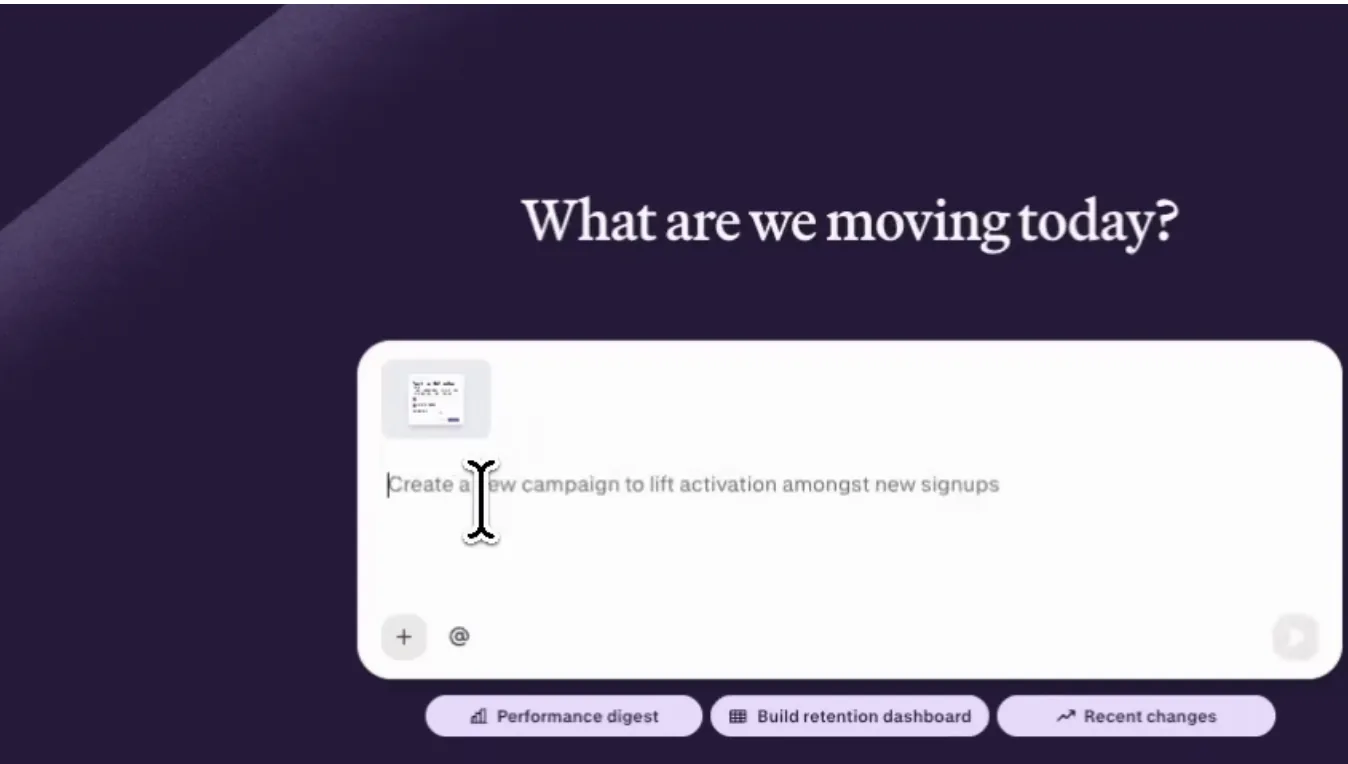
- AI-powered material creation and strategy planning via conversational agentic AI chatbot
- Email and push notifications via Appcues Workflows, a multichannel campaign management canvas that allows you to create automated communication flows for both in-app and off-app user experiences
Appcues supports web plus native iOS, Android, and React Native apps. That multi-platform reach is one of its main selling points, and it also shapes the price.
👉🏻 For a deeper look at the product itself, see our guide on what Appcues is.
How Much is Appcues?
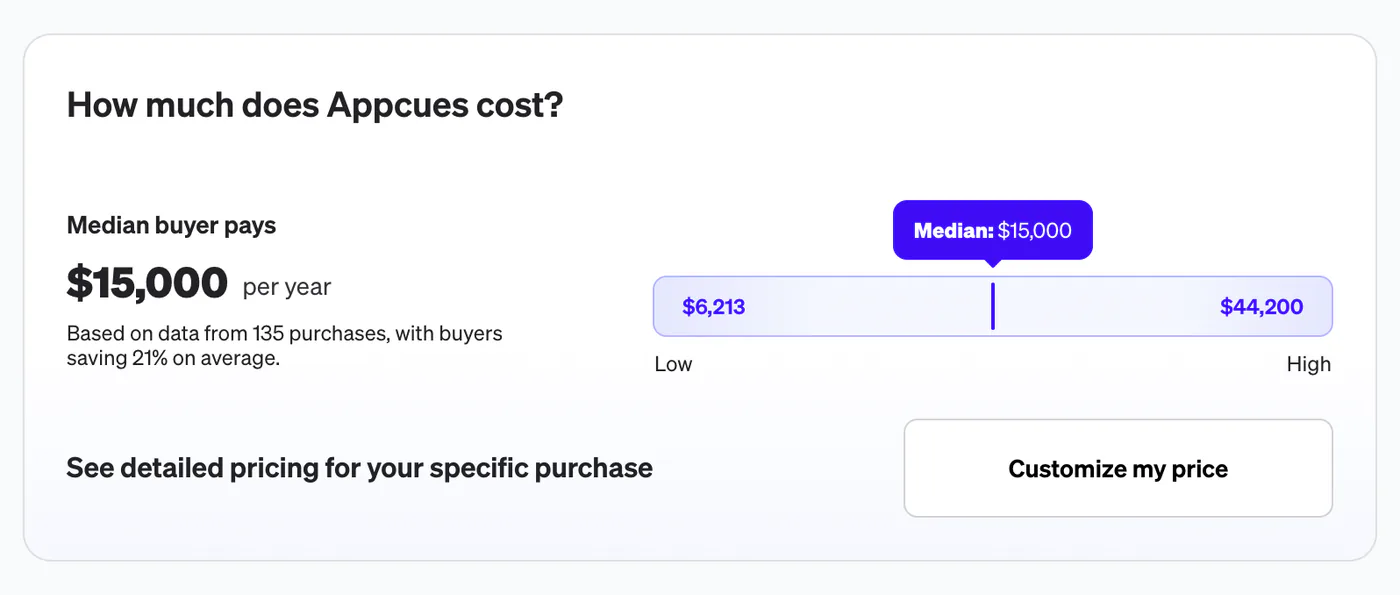
Appcues doesn't publish prices for its main plans. You'll need to book a demo to get a quote. Based on Vendr's purchase data, most teams pay between $6,200 and $44,200 per year, with an average contract of about $15,000 per year. This translates to an average of $1,250 per month.
⚠️ Appcues has a separate plan called "Appcues Spark," which it announces but doesn't really highlight on its main pricing page. Appcues Spark is for teams of 25 members or fewer that are just getting started with onboarding and in-app experiences.
Appcues generously offers all platform capabilities and available integrations with this plan. However, there's a 10-experience cap, which isn't so low that you can't create any meaningfully personalized experiences, but isn't high enough to sustain you for long as you grow.
Spark starts at $3,600/yr for up to 1,000 MAU, plus a one-time implementation fee of $250.
While Spark looks like a plan for startups, it still costs around $300 per month (without the implementation fee).
So, compared to other Appcues alternatives (not even counting free tools), Appcues Spark still isn't very budget-friendly or accessible for small teams and startups.
What Impacts Appcues’ Pricing?
Appcues used to hide its advanced features and integrations behind more expensive tiers, and was often criticized for it. However, with the new pricing structure, they changed their approach to feature-gating, too.
Now, Appcues offers all its features, capabilities, and integrations to all customers across different pricing tiers.
Appcues’ pricing plans now mainly depend not on included features, but on experience caps, reporting history, number of MAUs, priority support, and, for the Spark plan, number of team members, as we just discussed.
- Monthly active users (MAUs)
Spark includes 1,000 MAUs and can't scale up. Similarly, Start includes 3,000 MAUs and can't scale beyond that. Grow starts at 3,000 MAUs and scales up, but the minimum is 3,000. Enterprise has custom MAU volumes.
- Number of published experiences
Each plan caps how many experiences you can keep live: 10 on Start and Spark, 25 on Grow, and 100 on Enterprise. Teams that run onboarding, feature announcements, surveys, and checklists at the same time can hit 10 quickly. That pushes you to Grow even if your MAU count hasn't changed.
- Reporting history and support level
Higher tiers keep more data (12, 24, or 36 months) and add priority support. If you need year-over-year adoption reporting or fast responses, you'll be looking at Grow or Enterprise.
- Premium services and extra costs
Appcues offers premium services, though it doesn’t list prices for such services. Common options include enhanced setup, experience creation, account optimization, and team training.
For the Spark plan, there’s also a one-time implementation fee ($250).
- Contract length and billing
Appcues typically sells annual contracts. Vendr reports that multi-year commitments, annual prepayment (worth around 5 to 10%), and end-of-quarter timing are common ways buyers lower the price.
Is Appcues Worth the Cost? Pros and Cons of the Platform
✅ Appcues’ AI assistant, Captain AI, which is an in-app co-pilot mainly for analytics and experience management, is praised for its simplicity and output accuracy.
“Captain Assist is very intuitive and understands instructions and briefs very well. It’s easy to use, and it consistently follows what I ask without confusion.”
✅ Appcues’ mobile app experience features are an important factor in many of the platform’s customers.
Here’s a user praising the mobile features:
“Push notifications and workflows are amazing! Kudos to the team, it's easy to implement and use.”
✅ Appcues has a responsive support team, as well as a well-maintained self-serve help center, which allows you to access help whichever way you prefer.
❌ Appcues has a steep learning curve, and many users require additional dev support, even if not during the initial implementation, at the very least, during maintenance and personalization.
“The learning curve of the editor and the limitations in design templates. It often requires dev intervention for customizations beyond the standard, and browser caching can delay the publication of changes.”
Several other users also complain about the initial implementation and setup process, too. For example, a recent Appcues customer says that even though the platform offers many powerful and cool features and capabilities, its poor usability and unintuitive UI upsets them.
“I think the UI is not great and it's tough to configure everything. Even though Appcues is very powerful, discovering those powerful features requires a very manual effort. I would say it's not user-friendly. The initial setup wasn't as great either because the user experience from the UI perspective has not been great. We would prefer if it was more self-serve so we could do things on our own.”
❌ Appcues’ out-of-the-box customization settings are limited. Several Appcues users criticize the platform’s customization settings, as well as the segmentation settings for not being so intuitive or flexible.
As one customer on G2 puts it:
“The settings have some limitations and is a bit difficult to use. It really feels quite binary sometimes, like showing the flow once or all the time. There's also difficulty in creating segmentations with multiple layers, especially if the data comes from different sources. The builder could also be more intuitive. Some basic tasks, such as aligning text or resizing a YouTube video, can be more difficult than expected and require more effort than they probably should.”
❌ Appcues doesn’t offer material management capabilities, which can make flows hard to maintain and update, especially if you manage a lot of segments and/or create materials for different locals.
Here’s how an Appcues user explains this situation:
“I dislike how Appcues isn't optimized for clients who have a large number of flows. It's hard to stay organized with the current Flows tab. It would be helpful to have buckets or folders with sub-folders to keep flows in (I'll often have an overarching campaign with different regional and persona-based flows within it).”
❌ As discussed above, Appcues is not a budget-friendly or easily-scalable solution, especially if you’re not a big enterprise. Justifying the cost of the platform can be hard for many teams.
Additionally, while all plans technically come with all capabilities, which sounds pretty amazing, the total active experience caps are pretty low, and considering how all banners, checklists, guides, and pop-ups count collectively, you either need to go up pricing tiers pretty quickly, or write a pros/cons list before creating any experience…
If you have budget concerns and you’re not in the top pricing tier, then creating in-app experiences and personalizing user communication becomes a stressful experience for you.
A More Scalable Alternative to Appcues: UserGuiding
UserGuiding is a no-code product adoption platform built for user onboarding, feature announcement, in-app guidance, automated and self-serve customer support, customer feedback, and product planning.
With UserGuiding, you can build:
- Product tours
- Tooltips and hotspots
- Banners
- Checklists
- Resource centers
- Surveys and NPS
- Knowledge bases
- Product updates
- AI assistants
- Analytics
- Session replay
- No-code event tracking
- MCP (Model Context Protocol)
- Custom alerts
- Feature request boards
- Public/Private product roadmaps
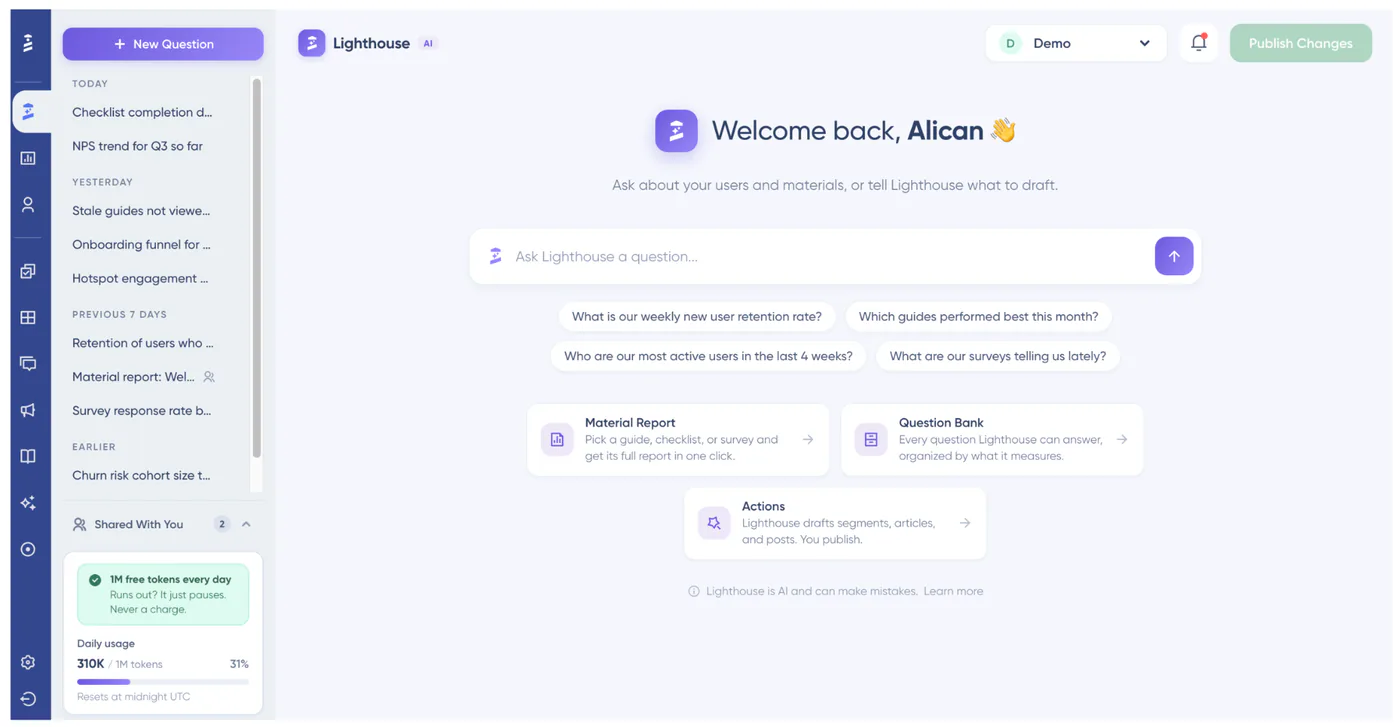
- Lighthouse AI (a conversational AI agent that lives inside the UserGuiding panel and allows you to ask questions about your materials and user segments)
👉🏻 Read more about UserGuiding’s features and use cases.
How Much is UserGuiding?
UserGuiding has an MAU-based pricing model that is also transparent and flexible. There are 3 plans: Starter, Growth, and Enterprise.
- Starter starts at $249/month (when billed yearly)
- Growth starts at $499/month (when billed yearly)
- Enterprise has custom pricing
Both Starter and Growth start at 2,000 MAU. Starter can scale up to 10,000 MAU, and Growth can scale up to 100,000 MAU.
All plans also have both yearly and monthly billing options.
Annual billing saves $1,200/year on Starter and $2,400/year on Growth compared with monthly billing.
The Starter Plan gives you most of UserGuiding's core toolkit: guides, hotspots, checklists, surveys, resource centers, a knowledge base, product updates, analytics, and AI capabilities (AI assistant, MCP, and Lighthouse AI).
With reasonable feature caps, of course.
Growth raises those limits and adds the tools teams need to scale adoption, like no-code event tracking, A/B testing, goal tracking, feature requests, and a public roadmap, along with more customization and localization options.
⚠️ Lighthouse AI is currently in beta, but it's still included in all plans.
Why do teams switch from Appcues to UserGuiding?
- A lower learning curve: UserGuiding is built so that anyone on your team, from product managers to customer success, can pick it up quickly. There's no long ramp-up period or onboarding for your onboarding tool.
- A true no-code experience: Beyond installing a single code snippet, you won't need engineering help to build, style, or publish your experiences. Most teams go live within hours, not weeks.
- A richer, use-case-oriented template gallery: Instead of starting from a blank canvas, you can pick a template built for what you're trying to do, whether that's welcoming new users, announcing a feature, or collecting feedback, and simply tweak it to match your product.
- Transparent, predictable pricing: Prices are public, monthly billing is an option, and if you go over your MAU quota, your guides pause until you upgrade instead of an overage bill showing up.
- A low-risk start: You can begin a 14-day free trial without a credit card or a sales call.
Choosing the Right Appcues Plan or the Alternative
The right choice depends on your team size, user base, platforms, and how many experiences you plan to run at once.
You can negotiate a plan with Appcues’ sales team, if…
- Your product runs on both web and native mobile (iOS, Android, or React Native), and you want one tool to cover them all
- You want in-app flows, emails, and push notifications in a single workflow
- You have the budget for a five-figure annual contract (the average is around $15,000/year)
- You're comfortable committing to an annual contract and going through a sales process to get there
You should go with an alternative, like UserGuiding, if…
- Your product is web-based, and you don't want to pay for mobile capabilities
- You want to know exactly what you'll pay before you ever talk to sales
- You'd like the option to pay monthly, or to start a free trial on your own
- You're a small team, and $3,600/year for 1,000 MAUs feels like a stretch
- You want predictable costs as you grow, with no surprise overage bills
- You want faster implementation, a lower learning curve, and overall easier and more intuitive usability
The gap is widest for small and mid-sized web products. UserGuiding's Starter plan, at $2,988/year for 2,000 MAUs, costs less than Appcues Spark at $3,600/year for 1,000 MAUs. And the Growth plan, at $5,988/year, is well under half of Appcues' average contract.
And once you factor in everything else, like transparent pricing, a monthly billing option (which Appcues doesn't offer), and a free trial you can start without booking a call with the sales team, UserGuiding comes out as the more flexible and scalable choice for most growing SaaS teams.
🎁 If you'd like to see it for yourself, you can start a free UserGuiding trial and build your first guide within minutes!
👉🏻 If you’re still not sure and would like to compare Appcues with more alternatives, here are the best Appcues alternatives for different budgets and priorities.
Frequently Asked Questions
How much does Appcues cost?
Appcues doesn't publish prices for its Start, Grow, and Enterprise plans, so you'll need to talk to sales for a quote. Based on Vendr's data, most teams pay between $6,200 and $44,200 per year, with an average contract of around $15,000. The only plan with a public price is Spark, which costs $3,600/year plus a one-time $250 implementation fee, for teams of 25 or fewer with up to 1,000 MAUs.
What is Appcues used for?
Appcues is used to build in-app experiences for web and mobile products. You can use it to onboard new users with product tours and checklists, drive feature adoption, convert trial users, collect feedback through NPS and in-app surveys, and offer self-serve help through resource centers. The platform also offers capabilities for workflow automation and multi-channel communication, such as behavior-triggered emails and push notifications.
What is the best Appcues alternative for SMBs?
For small and mid-sized businesses with web-based products, UserGuiding is one of the best Appcues alternatives. UserGuiding is an all-in-one product adoption platform, meaning that it offers all the core onboarding, in-app guidance, feature promotion, automated customer support, and customer feedback capabilities offered by Appcues. UserGuiding also offers standalone knowledge bases, product updates, roadmaps, and feature request boards. UserGuiding's Lighthouse AI, which is currently in beta, is also a close alternative to Appcues AI, as it allows you to get engagement reports conversationally and ask questions about your user segments and their engagement trends.
What makes UserGuiding the perfect alternative to Appcues for SMBs is that while what you get from the platform is pretty close, the pricing points are far from Appcues'. UserGuiding has a transparent and flexible pricing structure, with the Starter plan at $249/month and the Growth plan at $499/month (when billed yearly). You can also choose monthly billing if you don't want to commit to a full year. To put that into perspective, a full year of UserGuiding's Starter plan costs $2,988, which is less than Appcues Spark's $3,600 for half the MAUs. And even the Growth plan, at $5,988/year, comes in well under half of the roughly $15,000 an average Appcues contract costs.