

.svg)
.svg)
.svg)
.svg)



.svg)




.svg)
.svg)

Over the last few months, I have reached out to product practitioners in my community—Product Managers, Product Owners, Heads of Product, and product leaders — across SaaS, fintech, healthtech, consumer products, and enterprise platforms.
I asked them three open-ended questions about what they expect to see in 2026.
This wasn’t meant to be a large research operation.
It began as a simple curiosity:
What do product people, working inside real teams and shipping real products, believe is coming next?
Thirty-one people took the time to reply in detail. Their responses were thoughtful, candid, and often deeply reflective of the pressures and opportunities teams face today. This mini-report is a synthesis of those voices.
- 32 total participants answered the questions.
- Roles included: Heads of Product, Senior PMs, Product Owners, CPOs, Product Designers
- Industry mix: SaaS, fintech, health-tech, B2B, hardware, consumer tech, enterprise, regulated industries
- The format: Fully open-ended survey via LinkedIn direct messages.
- Excluding solely AI-based innovations, what new trends would you expect to see in the product field in 2026?
- What are your expectations for AI in 2026 from a product perspective?
- What is a change you expect to see in user onboarding practices in 2026?
Quantifying the Insights: How Often These Themes Appeared
These insights came from open-ended conversations, so the percentage values below show how often a theme appeared, not how many people agreed or disagreed with a statement.
Frequency of mention reveals signal strength, the patterns most top-of-mind for product practitioners.
Non-AI Product Expectations in Stats 📈
Personalization will become a core expectation — mentioned by 73%
Personalization is becoming a baseline expectation embedded into every layer of the product. Respondents described personalization that adapts interfaces, workflows, and feature exposure to a user's role, skill level, maturity, and context.
Generic user journeys will feel increasingly outdated as products compete on relevance rather than breadth, and personalization will matter not only at onboarding but throughout the entire lifecycle.
Manue Marévéry, Consumer Sciences Manager:
"Better personalization, instant adaptation to context and trends”
Vishal Gupta, Head of Product Engineering | Technical Architect:
“Enhanced personalization”
Products will behave like connected ecosystems — mentioned by 63%
Respondents described a shift away from isolated applications toward systems that interact seamlessly with tools, data sources, and user workflows. Value will come from how smoothly products integrate into operational stacks and real-world environments. Several participants pointed to ecosystem-level thinking, context-aware systems, and experiences that reduce friction across entire journeys.
Ketlin Barbon, Product Owner:
“In 2026, I expect the product field to shift toward a more integrated model where regulation, operations, and customer experience stop being independent layers and become a single product ecosystem.”
Manue Marévéry, Consumer Sciences Manager:
“Experience-oriented product, full integration with consumer workflow, smoother features”
AI Product Expectations in Stats 📈
AI becomes the operational layer behind products — mentioned by 76%
Respondents expect AI to evolve from a feature into the engine that powers decisions, automations, and optimizations inside products. AI will increasingly act as the underlying logic layer that determines what users see, how flows adapt, and how the system behaves in real time.
Harshita S, Engineering enterprise software | Ex - Meta:
“AI-assisted product usage → auto next-step suggestions (…) (Overall: AI becomes the logic layer behind product decisions, not just a chatbot.)”
Ketlin Barbon, Product Owner:
“When it comes to AI, I see 2026 as the year when AI stops being a ‘nice-to-have’ and becomes the baseline for every serious product. Instead of generative-text fireworks, we’ll see AI acting as an operational copilot, detecting inconsistencies, preventing errors before they happen, and enabling real-time decision support in areas that depend heavily on accuracy (...).”
AI automates a meaningful portion of PM workflows — mentioned by 70%
Respondents described a future where AI handles operational product tasks like research synthesis, insight generation, backlog grooming, prioritization, and early prototyping. This shift gives teams more time for strategy and experimentation, while smaller teams deliver more with less effort.
Emerson Vieira — Head of IT and Products:
“Co-pilots automating 30–50% of PM tasks. Analytics, prioritization, insights, and initial discovery partially automated.”
Rowan Milwid, VP Product:
“PMs and Designers will be expected to know how to prototype with AI tools (…) the ideal team size will become smaller, and the role of a PM will shift left.”
Onboarding Expectations in Stats 📈
Onboarding becomes fully adaptive and personalized — mentioned by 80%
Respondents expect onboarding to evolve into a real-time system that adjusts itself based on user behavior, maturity, context, and intent. Instead of static sequences, onboarding will become a living experience that changes continuously as the user interacts with the product.
Anaïs Moulin, Product Owner @ Ippon Technologies | Speaker:
“That the onboarding will no longer be a static sequence, it will adapt automatically to: user intent inferred from early actions, skill level, industry, past behaviors or imported data…”
Emerson Vieira — Head of IT and Products:
“Fully adaptive onboarding. Flows that change in real time according to user behavior, maturity, and context.”
Onboarding becomes shorter, contextual, and triggered when needed — mentioned by 70%
Respondents described onboarding that emerges only when relevant, using contextual triggers and micro-aha moments instead of long, front-loaded tours. Guidance becomes precise, timely, and integrated into the real flow of the product.
Harshita S, Engineering enterprise software | Ex - Meta:
“Let users experience a small win first, then guide them based on what they actually do, and show guidance again only when contextually relevant.”
Uche Mukolo — Product Manager / Owner:
“Onboarding will be smarter and ongoing (…) quick in-app guides, micro-learning, and helpful tips that appear when needed, instead of long instruction manuals.”
Trends: Non-AI Product Trends to Expect in 2026
This section expands on the patterns surfaced in the conversations and adds broader context to why product leaders feel these changes are coming.
1) Products Become Integrated, Contextual & Ecosystem-Driven
Several respondents described a shift away from standalone applications toward environments that behave more like connected, interoperable ecosystems. The pressure for smoother operational workflows, cleaner integrations, and increasingly complex user journeys seems to be reshaping expectations around how products should function.
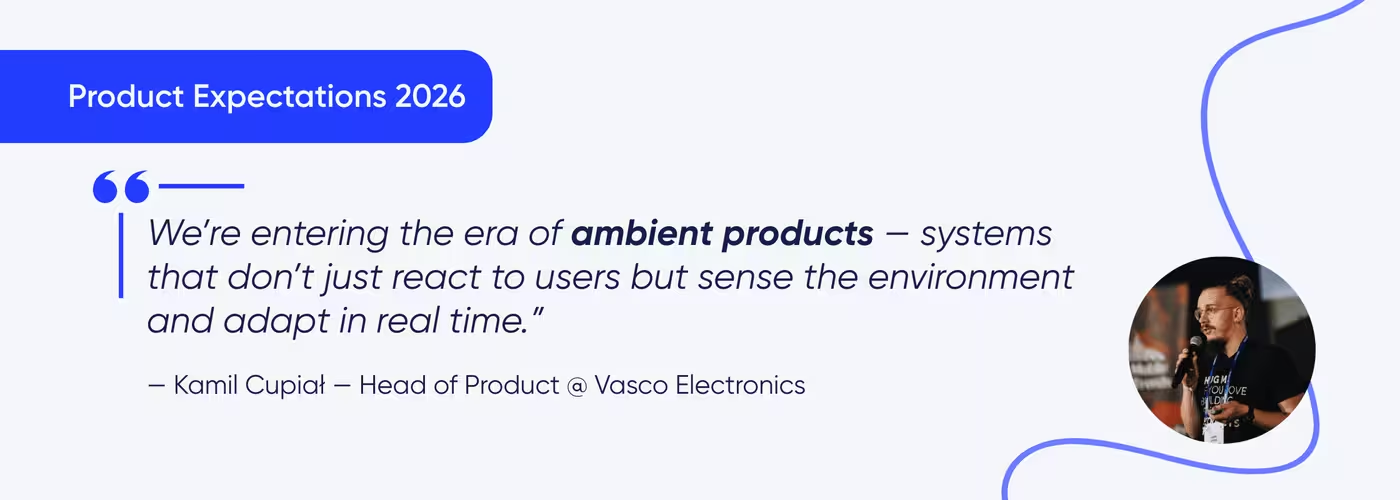
Many described products that “fade into the background,” interacting with their environment rather than demanding attention. This includes context-aware systems, minimal UI, gesture-based interactions, and UX that adapts automatically to what the user is trying to do next. One participant, Kamil, put it succinctly in the context of ambient products:
Kamil Cupiał, Head of Product @ Vasco Electronics:
“We’re entering the era of ambient products: systems that don’t just react to users but sense the environment and adapt in real time.”
Another participant, Łukasz, highlighted the move toward invisible interfaces:
Łukasz Miądowicz — Senior Product Manager:
“Products will move towards invisible interfaces: gesture, voice, ambient feedback, simpler flows. Products will adapt to the user's context.”
What ties these answers together is not a desire for flashier design, but for technology that integrates into the user’s broader environment in a way that reduces friction, noise, and effort.
2) Personalization Becomes a Core Requirement
Personalization came up frequently, not as a buzzword but as a structural requirement. Respondents described products that adapt to user role, skill maturity, workflow patterns, and even behavioral signals.
Eduardo Martín, Head of Product at Obi:
“I expect to see more product personalization (...)We are beginning to enter an exciting new era where users will begin to demand more to the products they use and we will have to deliver.”
This expectation isn’t about simple UI changes or toggle-based customization. It’s about creating product experiences that feel consciously aware of the user’s context—what they want to do, what they have already completed, and what outcome they’re seeking.
Harshita highlighted this with a practical framing for onboarding and guidance:
Harshita S, Engineering enterprise software | Ex - Meta:
“A lot of users skip onboarding simply because they haven’t tasted value yet — so it feels like friction without context. (...)And show guidance again only when contextually relevant.”
Together, these responses reveal a broad expectation that products in 2026 need to feel more adaptive, flexible, and tailored to individuals rather than segments.
3) Privacy, Governance & Responsible Design Rise in Importance
An important pattern—especially among respondents in healthtech and regulated industries—was the belief that privacy, governance, and responsible data usage will become essential parts of product value in 2026.
Sara Marska-Maj — Head of Product at Mira:
“I hope to see more concern about data privacy and greater responsibility in how we use AI, especially in health-tech. Too many companies are jumping on the AI bandwagon without a clear strategy or the caution required when handling sensitive information and giving health-related recommendations.”
Participants noted that AI-driven products raise new governance expectations, making transparency, auditability, and ethical decision-making central to product strategy.
This reflects a more mature stage in digital products where value is not simply in what you offer, but also in how safely, responsibly, and transparently you offer it.
4) Product Roles & Team Structures Will Shift
Several respondents predicted visible changes in how product teams are structured. Many expect Product Ops to become more strategic, PM and Design responsibilities to blend, and smaller squads to become more common as AI accelerates production cycles.
Rowan Milwid, VP Product:
“My prediction is that the ideal team size will become smaller, and the role of a PM will shift left - leaving behind many of the already waning concepts of POs and scrum in favour of something more suited to rapid prototyping and fast iterations (so more test & learn and less plan and execute).”
Malte Landwehr, CPO & CMO, Peec AI:
“Up to a point where some companies might not need Product Managers any more. Just one Product Lead overseeing a portfolio of products; each with their own Product Designer.”
This reflects a broader expectation: by 2026, the shape of product teams may be as different as the products themselves.
5) A Shift From Shipping Features to Delivering Value
Respondents talked about a maturing product mindset—one where teams focus less on outputs and more on outcomes. This includes driving meaningful value, solving real user problems, and measuring success based on impact rather than velocity.
Ed Valdez, Product Manager | ex-Amazon:
“I think in 2026, product teams will focus less on shipping more features and more on solving real problems for users. (...)I think the real shift isn’t about new tech per se. It’s about focusing on what actually helps users and drives value (at least that is sort of my hope).”
Across participants, there was a shared understanding that teams in 2026 will need to speak the language of business and user value more fluently than ever.
Trends: AI Expectations From a Product Perspective in 2026
AI was present in nearly every response, but not in the form of superficial feature-addition. Instead, participants described structural and operational shifts powered by AI.
1) AI Becomes the Operational Layer Behind Products
Participants consistently described AI not as “a feature” but as the foundation beneath product workflows. This includes AI-driven decision-making, adaptive UX, automated analysis, real-time optimization, and agentic behavior.
Kirill A. Balakhonov, Product Leader & AI:
“AI moves from ‘feature’ to ‘operator of the system.’ Not just copilots in a sidebar, but agents that own a slice of the workflow end-to-end: monitoring, acting, escalating, and explaining their decisions.”
Another respondent, Emerson, framed this in terms of workload:
Emerson Vieira — Head of IT and Products:
“Co-pilots automating 30–50% of PM tasksAnalytics, prioritization, insights, and initial discovery partially automated.”
The expectation is that AI will sit inside the product, beneath the product, and behind the product—shaping how it functions in a more operational and autonomous way.
2) AI Will Automate a Meaningful Portion of Product Workflows
The idea that AI will automate significant PM workload appeared repeatedly. This includes synthesis of research, documentation, prioritization, backlog grooming, opportunity mapping, KPI analysis, and more.
Felipe Camargo, Digital Product Leader:
“For me, it’s almost impossible to disconnect AI from product trends. I can already see emerging practices such as deeply data-driven decisions and insights, and large-scale experimentation powered by vibe-coding solutions. (...)Launches and feature development will be accelerated at scale.”
Many respondents noted that AI tools will enable PMs and designers to prototype independently, shifting engineering involvement later in the process. This creates faster experimentation, tighter feedback loops, and more iterative learning.
Trends: How User Onboarding Is Expected to Change in 2026
The onboarding section generated some of the strongest consensus and clearest directionality in the entire dataset.
1) Onboarding Becomes Fully Adaptive & Personalized
The strongest onboarding theme across all responses was the belief that onboarding will adapt to user behavior, context, intent, role, and maturity—often in real time.
Anaïs Moulin, Product Owner @ Ippon Technologies | Speaker:
“That the onboarding will no longer be a static sequence, it will adapt automatically to: user intent inferred from early actions, skill level, industry, past behaviors or imported data…”
Participants also emphasized longer-term, continuous onboarding systems that guide users throughout the lifecycle rather than during their first session. This includes responsive flows that update based on user action, not predefined steps.
2) Onboarding Becomes Shorter, Contextual & Trigger-Based
A major theme was the move away from long, linear tours and toward contextual micro-guidance.
Harshita S, Engineering enterprise software | Ex - Meta:
“From what I’m seeing, onboarding is gradually shifting from traditional “show everything upfront” tours toward adaptive, value-first flows. (...)The newer pattern is:– Let users experience a small win first– Then guide them based on what they actually do– And show guidance again only when contextually relevant”
Participants expect onboarding experiences that emerge only when needed and only in ways that meaningfully move the user forward. This includes micro-aha moments, dynamic prompts, and workflows driven by user intent rather than product structure.
Surprises & Outliers
While most responses clustered around predictable themes—personalization, AI as infrastructure, adaptive onboarding—a handful of participants shared contrarian or speculative predictions.
These outliers are valuable because they highlight tensions in the field, reveal alternative futures, and expose the edges of how product practitioners are thinking about 2026.
Below is a deeper look at each outlier and what it represents.
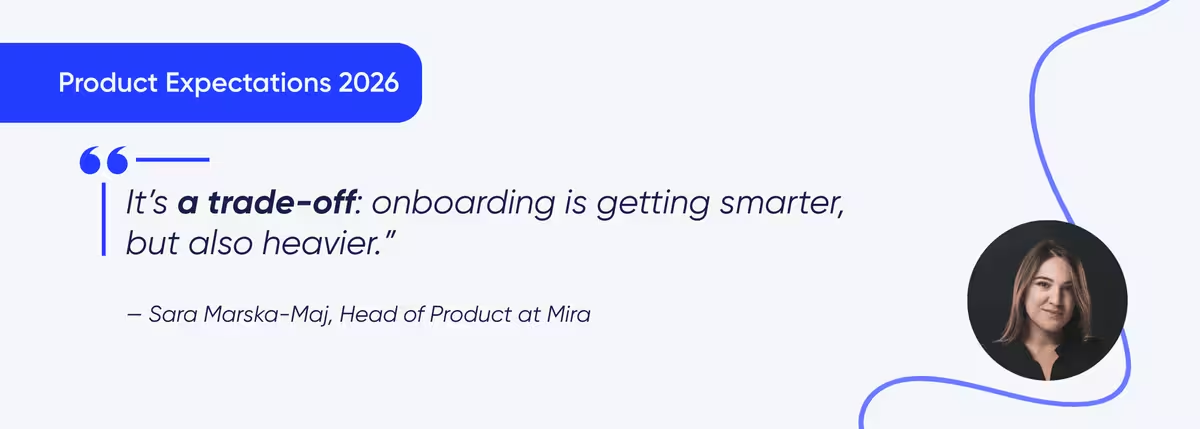
1. “Onboarding might become heavier, not lighter.” — Sara Marska-Maj, Head of Product at Mira
Sara’s perspective breaks from the dominant belief that onboarding will shrink. She suggests that onboarding may actually expand because it becomes the mechanism through which AI systems learn, segment users, and tailor product experiences.
Sara Marska-Maj:
“I wish I could say that by 2026 onboarding processes will become shorter, or even disappear entirely, that users will simply learn the product by using it. But in reality, I expect them to become even more complex. (...) It’s a trade-off: onboarding is getting smarter, but also heavier.”
2. “Onboarding disappears entirely.” — Manue Marévéry, Consumer Sciences Manager
Manue imagines the opposite extreme: onboarding dissolves into a world where products are so intuitive—and AI so embedded—that explicit guidance is unnecessary.
Manue Marévéry:
“no onboarding at all, as AI will make onboarding as natural as possible. experience will start asap”
3. “Login with ChatGPT becomes common.” — Malte Landwehr, CPO & CMO, Peec AI
Malte predicts a future where authentication itself is disrupted.
Malte Landwehr:
“I expect more ‘login with ChatGPT’ options.”
4. “Agentic systems reduce interfaces altogether.” — Marcelo Bomura Abe, Product & Development Leader
Marcelo pushes the boundaries even further, suggesting that agentic AI may handle tasks autonomously—potentially eliminating many interface surfaces.
Marcelo Bomura Abe:
“Another point is that, with Agentic AI, we will have fewer operational interfaces and more monitoring interfaces. (...) there will be fewer and fewer users and interfaces, as autonomous agents will operate the systems.”
5. “PM roles partially merge with Product Design.” — Malte Landwehr, CPO & CMO, Peec AI
Malte also anticipates a structural change in roles.
Malte Landwehr:
“I see the Product Manager and Product Designer roles converging. Up to a point where some companies might not need Product Managers any more. Just one Product Lead overseeing a portfolio of products; each with their own Product Designer.”
6. “Natural language replaces dashboards entirely.” — Rowan Milwid, VP Product
Rowan predicts that dashboards may give way to conversational analytics.
Rowan Milwid:
“Product and Engineering folks will realise how easy it is to use an LLM to convert natural language into SQL queries, and the era of traditional dash boarding will be over.”
7. “2026 becomes the AI cleanup era.” — Kylie Sirico, Senior Product Manager & AI Product Instructor
Kylie introduces a perspective absent from all other responses: the idea that after the chaotic AI-prototyping boom of 2023–2025, teams will be forced into a cleanup and governance cycle. Her prediction reframes the next phase not as acceleration, but as consolidation, where the real work lies in data integrity, evaluation frameworks, model transparency, and new forms of user education.
Kylie Sirico:
“We are reaching a point where product teams will need to clean up the work created during the AI prototyping rush. I expect a shift toward higher standards around data integrity, better evaluation frameworks, and structured experimentation.”
She also suggests that product teams will increasingly need to manage user trust, model clarity, opt-in training, and how AI outputs are interpreted, making responsible AI a core part of the product experience rather than a backend consideration.
Why these outliers matter
Together, these outliers signal the speculative but plausible edges of product thinking:
- The role of onboarding is contested, from heavier and data-driven to disappearing entirely.
- Interfaces may shrink dramatically if agents become the primary operators.
- Identity and authentication could shift toward AI intermediaries.
- Product roles may evolve into new, hybrid forms.
- Analytics and dashboards may be replaced by conversational systems.
- 2026 may become the year of AI cleanup, governance, and responsible evaluation, a counterbalance to the rapid prototyping era.
These predictions reveal a shared willingness among product practitioners to imagine structural, not just incremental, changes in how products are built, used, and understood.
2026 Product Expectations Questions
Here are the questions asked to the 32 participants:
- Excluding solely AI-based innovations, what new trends would you expect to see in the product field in 2026?
- What are your expectations for AI in 2026 from a product perspective?
- What is a change you expect to see in user onboarding practices in 2026?
2026 Product Expectations Answers
Sara Marska-Maj — Head of Product at Mira
1 - I hope to see more concern about data privacy and greater responsibility in how we use AI, especially in health-tech. Too many companies are jumping on the AI bandwagon without a clear strategy or the caution required when handling sensitive information and giving health-related recommendations.
That said, I also expect to see a continued shift toward integrating physical and digital experiences, along with deeper personalization and customization. The opportunities to analyze and interpret large datasets from multiple sources, and to translate them into meaningful, human experiences, have never been greater. The more human we can make technology feel to the end user, the more our products will stand out but we do need to balance it with safety.
2 - Rather than focusing on the end product impact, which I expect will keep evolving in the current direction, I’m thinking about how AI will reshape the process of building it.
By 2026, I expect AI to become a core part of the product workflow, streamlining operational aspects of product work such as analysing feedback and data, summarising research and supporting the documentation. I also see a potential for AI to bridge the product, tech and design teams in areas that often create friction — from translating business needs into technical requirements to improving alignment and handovers across disciplines.
In the long run, I believe AI will help product teams spend less time managing process and more time shaping direction together.
3 - I wish I could say that by 2026 onboarding processes will become shorter, or even disappear entirely, that users will simply learn the product by using it. But in reality, I expect them to become even more complex.
Many teams are treating onboarding not just as education or activation, but as a data collection and segmentation phase. Early interactions are being used to label users, personalize journeys, and train AI models to recognize intent, behavioural patterns and to put a pay-wall in just the right moment.
It’s a trade-off: onboarding is getting smarter, but also heavier. The challenge for product teams will be to make this invisible to the user so the experience still feels natural and intuitive, even if there’s a lot happening in the background.
Leonardo Canuto — Product Manager / Product Owner
1 - I think that outside of AI, a foundation that's coming very strong is system integrations, what we call the glue between various digital or embedded systems. I believe in the trend of products that create more seamless, integrated experiences, like complete user journeys where users can flow from end to end.
2 - AI in product can be viewed in different aspects. Today I see AI as an integrated journey from Discovery to Delivery. AI is part of the entire product cycle and for 2026 the trend is that this increases exponentially, when we talk about faster testing, high-fidelity low-cost prototypes, dynamic and iterative testing, and much more. In Delivery, product pipelines that will deliver and validate requirements faster, dynamic testing, and much more. A trend that is certainly revolutionizing is AI connected to healthcare and mental health, this will certainly be an extraordinary gain for the entire world.
3 - AI is the key word. Onboarding is 100% related to customer success and to ensure this efficiently, we have a universe of possibilities to explore customized, dynamic paths that match the customer's profile. Companies that don't adapt will lose humanization in onboarding and this will certainly be a differentiator in customer loyalty and retention.
Kamil Cupiał — Head of Product @ Vasco Electronics
1 - By 2026, product innovation will finally step off the app screen and into the real world — in ways that feel almost like science fiction, yet are already taking shape.
We’re entering the era of ambient products: systems that don’t just react to users but sense the environment and adapt in real time. Think of a translation device that recognizes you’re in a crowded market in Bangkok and automatically tunes its microphones to filter out background noise. Or one that subtly adjusts tone and pacing based on who you’re speaking with.
Another big shift will be product elasticity. The idea of a “finished product” is fading fast. With modular hardware, firmware updates, and cloud-linked intelligence, what you buy in 2026 might look completely different in 2028, not because it’s replaced, but because it evolves with you.
And perhaps most crucially, security and trust will become key elements of desirability. As people grow more aware of what “smart” really means, they’ll choose products that respect privacy, handle data responsibly, and are transparent about how they work.
But the wild part is this: the line between human and product behavior is going to blur much faster than most expect. We’ll start seeing devices that collaborate with one another, negotiating connectivity, sharing context, or deciding which one should take the lead in a given situation.
2 - I’d say our AI journey is only just beginning. Right now, we’re in the “AI-everywhere” phase — adding it to almost everything simply because we can. Some of those experiments make real sense; others don’t. But that’s part of every technological turning point.
By 2026, “powered by AI” will be a baseline standard, not a differentiator. What will matter is how responsibly and intelligently we use it. AI should simplify, not overcomplicate. It should anticipate friction, strengthen safety, and adapt quietly to human needs rather than trying to impress us.
3 - No answer provided.
Łukasz Miądowicz — Senior Product Manager
1 - Interface minimalism and contextual computing: Products will move toward invisible interfaces: gesture, voice, ambient feedback, simpler flows. Products will adapt to the user's context. Attention is an increasingly scarcer commodity. Products that minimize cognitive load will win.
2 - Adaptive product roadmaps, user interfaces that learn, and AI-enhanced user empathy.
3 - By 2026, traditional onboarding methods will feel outdated. AI copilots will deliver living, adaptive guidance that evolves in real time based on each user’s intent, skill level, role, and behavior.
Eduardo Martín — Head of Product at Obi
1 - I expect to see more product personalization. Our job at product managers is to solve users problems in the easiest and best way possible while giving the best user experience. One product can not serve all your user base specific use cases. But here is where product personalization comes into play, companies who will be able to configure and personalize the UI and user experience to their user base will see massive engagement and growth. It will be difficult at first to make users see the benefits of product personalization but it will pay off. We are beginning to enter an exciting new era where users will begin to demand more to the products they use and we will have to deliver.
2 - My main expectation are the following:
To be used more broadly in teams besides development. I think we will begin to see design and product teams using more AI than we have done in the past few years to prototype, get user insights faster, automate user interviews or feedback or even having PMs agents that manage the Jira board.
From a product growth perspective AI possibilities are endless, from programmatic SEO to new kind of growth loops linked with users personalization. I’ve already seen a lot of companies growing in ways there were not possible before and this will become the norm.
It will also help with product personalization but here hallucinations may hurt the user experience so it has to be used wisely and carefully
3 - I consider those companies who pushes for user personalization will need to have two different onboarding experiences since the beginning. One shorter for those users who want to quickly understand and feel the product and another one longer due to the number of questions required for the personalization. Therefore two completely different product experiences will be present for users and we will need to measure this accordingly and take it into account. Would users with personalized onboarding have more engagement and LTV? Would user on those onboardings be more profitable than the other ones? It will depend on the product and how fast users are educated or perceived the product value.
Vishal Gupta — Head of Product Engineering | Technical Architect
1 - First point:
- Sustainable and eco-friendly products
- Health and wellness tech
- Augmented Reality (AR) integration
- Voice-controlled smart home devices
- Personalized learning tools
2 - Second point
- Enhanced personalization
- Improved customer support
- Predictive maintenance and analytics
- AI-driven content creation
- Ethical AI practices
3 - Third point
- Interactive and gamified onboarding
- Personalized onboarding paths
- AI-driven onboarding
- Focus on accessibility
- Continuous onboarding
Uche Mukolo — Product Manager / Owner
1 - Product teams will rely more on data to make decisions, not just for tracking growth, but also for improving how users experience the product and how operations run. Another important change will be around sustainability and ethics. Products will need to be more open about how they use customer data, their environmental impact, and whether everyone can use them easily.
2 - AI will become a normal part of how products are built, not just an extra feature. It will help teams work faster by finding insights, deciding what to work on first, and automatically understanding what customers want. For example, AI could read all user feedback and create summaries, or predict which product improvements will matter most. It will also make products feel more personal to each user, without requiring product teams to do lots of manual customization.
3 - Onboarding will be smarter and ongoing, not just something that happens once when someone starts using a product. Products will watch how people use them and adjust what guidance they offer next. We'll also see more onboarding like quick in-app guides, micro-learning, and helpful tips that appear when needed, instead of long instruction manuals. For business software, onboarding will focus on helping users achieve something useful as quickly as possible.
Harshita S — Engineering Enterprise Software (Ex-Meta)
1 - Excluding purely AI, new trends in product (2026)
- More modular, composable product stacks. Like products will behave like building blocks; customers assemble workflows rather than use monoliths.
- Privacy-first UX. more transparency + lightweight consent surfaces baked into product flows.
- In-product education becomes continuous ongoing tips/announcements replace docs and lengthy release notes.
- Product-led growth gets more granular. activation → adoption → expansion tracked as separate journeys.
(Overall: products are becoming more contextual, flexible)
2 - Expectations for AI in product (2026)
- AI-assisted product usage → auto next-step suggestions
- “You’ve set up X, most users now connect Y → here’s how.”
- Automatic A/B & optimisation. Products will fine-tune UX flows automatically to reduce drop-off.
- Task-level agents embedded inside product
- Example: “Generate campaign → send → refine” without leaving UI.
- Smaller vertical models
- Faster, cheaper, domain-specific models embedded directly in app.
- AI-based segmentation & intent prediction. Recommending modules or plans based on behavioural patterns.
(Overall: AI becomes the logic layer behind product decisions, not just a chatbot.)
3 - From what I’m seeing, onboarding is gradually shifting from traditional “show everything upfront” tours toward adaptive, value-first flows.A lot of users skip onboarding simply because they haven’t tasted value yet — so it feels like friction without context.The newer pattern is:A few practical directions I’m excited about:
- Personalizing early steps depending on entry source (e.g., UTM → show the most relevant path)
- Triggered onboarding when the user touches a new feature, instead of front-loading everything
- Micro-aha chains vs. one big guided experience
- Using behaviour signals to surface the next best step rather than a predetermined checklist
- And of course — A/B testing these flows so the system evolves, not stays opinionated
This all leans towards a model where onboarding becomes less of a “tour”, and more of an adaptive success engine.
- Let users experience a small win first,
- Then guide them based on what they actually do,
- And show guidance again only when contextually relevant.
Manue Marévéry — Consumer Sciences Manager
1 - Experience-oriented product, full integration with consumer workflow, smoother features.
2 - Better personalization, instant adapation to context and trends.
3 - No onboarding at all, as AI will make onboarding as natural as possible. experience will start asap
Rowan Milwid — VP Product
1 - I only have one that stands out to me right now - and it's tangentially related to AI, but not an AI innovate: I expect that 2026 will finally be the year that Engineering teams become good at vibe coding, or the tools overcome the current resistance - to changing their workflows, learning to prompt and context engineer properly, etc (the vast majority are really not very good, including those who claim to use it a lot). There'll be a tipping point when the majority are doing it well, and that will change the way Product will need to work with Engineering in any organisation that wants to innovate and stay relevant. My prediction is that the ideal team size will become smaller, and the role of a PM will shift left - leaving behind many of the already waning concepts of POs and scrum in favour of something more suited to rapid prototyping and fast iterations (so more test & learn and less plan and execute).
2- Already mentioned above for Engineers.
PMs and Designers will be expected to know how to prototype with AI tools (already starting to be the case, but I predict it's going to shift rapidly soon).
Someone will release an AI coding tool that does context and coding properly, and it'll be a game changer. Essentially, LLMs are already WAY better at coding than most people realise, but currently there are only two types - built for engineers who don't want to change the way they work (like Cursor), and built for people who don't want to code at all (like Lovable). Someone is going to figure out that there's a big gap between the two and fill it. That will be the beginning of a wave of small, low cost, vertical, SaaS solutions that will truly disrupt markets.
Product and Engineering folks will realise how easy it is to use an LLM to convert natural language into SQL queries, and the era of traditional dash boarding will be over.
Many of the UX/UI concepts currently held to be truth will be upturned when people realise how to use AI agents properly to assist users with complex tasks (like configuration).
AI Agents will replace wizards, guided tours, tips, etc. Not chatbots per se, but hybrid UI experiences with chat as a part of it. The biggest issue with onboarding is that it currently focuses on training - introducing users to concepts, language, functionality, etc. What they really need is someone to translate their own needs without having to know where everything is and what it does. That's what future onboarding AI Agents will do.
Allan Melo — Product Designer
1 - Beyond AI, I believe we’ll see a strong trend toward data-driven personalization and closer collaboration between the products teams.
2 - By 2026, I expect AI to become more context-aware and collaborative, supporting the product teams in creative and strategic decisions not just operational tasks.
3 - In user onboarding, we’ll see more adaptive and interactive experiences, shaped by real-time user behavior, fewer generic tutorials, more intelligent journeys.
Waqas Khan — Product @ Valpak
1 - Excluding AI, product managers will have much more control and responsibility in the future. They’ll be expected to deliver workable prototypes to prove concepts and demonstrate strong business cases for their ideas, whether as standalone products or as features. By 2026, product managers will be required to handle more analytical work, including lifetime value assessments, user retention analysis, and funnel optimization. They’ll need to validate business potential before an idea even reaches the development stage.
2 - From an AI perspective, product management will evolve into a space where experience design and concept validation require little to no engineering involvement. Product managers will need a solid technical understanding that allows them to create full MVPs independently before involving development teams. This will speed up iteration cycles and help validate ideas earlier in the process.
3 - User onboarding will become far less reliant on large human support teams. Instead of hiring dozens of people for account management or customer support, companies will use AI and machine learning to personalize onboarding experiences. Algorithms will identify the best approach for each individual user, creating tailored onboarding paths rather than one-size-fits-all solutions. This will make the user experience more exclusive, adaptive, and engaging.
Malte Landwehr — CPO & CMO, Peec AI
1 - Not sure it is new. But I see the Product Manager and Product Designer roles converging. Up to a point where some companies might not need Product Managers any more. Just one Product Lead overseeing a portfolio of products; each with their own Product Designer.
2 - PMs who are not using Generative AI for prototyping and validation will be left behind.
The trend of "every product/feature needs AI" will hopefully stop at some point in 2026.
3 - I expect more "login with ChatGPT" options.
Ed Valdez — Product Manager (Ex-Amazon)
1 - I think in 2026, product teams will focus less on shipping more features and more on solving real problems for users. There are a lot of new PMs entering the field, and the space is getting crowded. The ones who stand out will be the ones who can prove their work creates real results for people and the business.
You’ll see more teams running quick tests, building flexible systems, and treating trust and privacy as part of the product from the start. I think the real shift isn’t about new tech per se. It’s about focusing on what actually helps users and drives value (at least that is sort of my hope).
2 - I think we’ll see more products using AI just because it’s trendy, not because it actually helps the user. As AI becomes expected, some teams will add it as a way to look modern or different. But if it doesn’t fit the problem or user need, it can feel forced and even hurt the brand.
You’ll see apps adding chatbots where simple filters or buttons work better, or “AI-powered” features that don’t add real value. Over time, users will tune that out and lose trust in brands that overuse the label.
So yes, AI will be everywhere, but the smart teams will be the ones that use it with purpose. Overusing it will make products feel gimmicky instead of helpful.
3 - I believe onboarding will shift from generic product tours to short, smart guidance that adjusts as people explore and learn.
From user interviews and my own experience, most people don’t have the patience to watch onboarding videos or long guides. They only do it when they’re stuck and it’s the last option. That’s why dynamic onboarding makes sense. It can read what users do in real time and surface tips that feel helpful, not forced.
Instead of a full walkthrough, users might see one short tip after setup, then a few hints that show up only when relevant. Each user’s flow could adapt to their own journey or goals.
So I expect onboarding to shift toward more personalized, dynamic guidance that respond to each user’s real behavior instead of pushing the same path to everyone.
Monik Gomes — Product Owner
1 - In 2026, I expect to see Product Ops becoming a fully established strategic function, standardizing metrics, governance, and rituals to help product teams scale efficiently. I also foresee the rise of modular and composable platforms, allowing companies to adapt their solutions quickly without long development cycles. Another strong trend will be the expansion of products built with stronger privacy, compliance, and digital responsibility requirements. And finally, co-creation with users will gain more relevance, with continuous testing and rapid feedback loops becoming the norm to validate hypotheses collaboratively.
2 - By 2026, I expect AI to evolve from an operational assistant into a decision orchestrator, supporting prioritization, opportunity identification, and journey design. AI will help PMs analyze large volumes of data and suggest potential directions — always with human oversight. Products will increasingly have native AI embedded across the entire user experience, making interfaces more contextual, adaptive, and personalized. The role of the PM will shift even more toward ensuring ethics, safety, accountability, and real-world impact in AI-assisted decision-making.
3 - Onboarding will become far more dynamic and behavior-driven, moving away from static flows. Users will receive personalized onboarding experiences based on their maturity, intent, and behavioral patterns. I also expect a shift toward continuous onboarding, supporting the user throughout their entire lifecycle rather than only during initial activation. Additionally, micro-interactions and contextual guidance will play a larger role, reducing friction and making onboarding more intuitive, educational, and relevant.
Emerson Vieira — Head of IT and Products
1 - a) Product as value orchestration, not feature delivery.
- Impact-driven roadmaps, more analytical PMs, and direct integration with finance and unit economics.
b) Product-Led Governance
- Corporate governance begins to use product metrics as a basis for strategic decisions.
c) Consolidation of Product Infrastructure
- Internal platforms, telemetry, reliability, and digital compliance become structuring areas.
d) Requirement for explainability and accountability
- Products need to be transparent about data, decisions, and risks — a requirement of the market and regulators.
e) Convergence between Product and Strategy
- Companies operate as "product companies," with strategic cycles driven by hypotheses and OKRs.
2 - a) AI as the backbone of workflows
- Products become predictive, adaptive, and self-optimizing — not just with "AI features".
b) PMs as AI behavior designers
- Expanded responsibilities to define boundaries, ethics, personalization, and "how AI should act".
c) Co-pilots automating 30–50% of PM tasks
- Analytics, prioritization, insights, and initial discovery partially automated.
d) Product creation via "AI scaffolding"
- Tools automatically generate backlogs, journeys, UX, and telemetry — reducing the idea → MVP cycle.
3 - a) Fully adaptive onboarding
- Flows that change in real time according to user behavior, maturity, and context.
b) Onboarding, activation, and value as a single flow
- Focus on reducing "Time to First Value" and accelerating the "aha" moment.
c) Conversational guides replacing tutorials
- Native assistants and internal co-pilots make onboarding more interactive.
d) Modular onboarding by user profile
- Distinct experiences for power users, beginners, and corporate clients — reducing churn and increasing activation.
Kirill A. Balakhonov — Product Leader & AI
1 - I expect a few non-AI headlines in product:
- Outcome-based and “shared upside” pricing in B2B. Less “$X per seat per month”, more “we take a cut of the value we actually generate” — especially in infra, security, and revenue tools.
- Deeper verticalization of products, not just horizontal “all-in-one platforms”. Teams will ship opinionated products for a specific industry, with workflows, data models, and compliance baked in from day one.
- Governance, auditability, and compliance as first-class features. With more regulation (finance, data, crypto), “show me what happened and why” becomes a core part of the product, not an afterthought.
- Tighter product–sales loops. PLG alone is maturing; 2026 will be more about product teams designing explicitly for sales assist, customer success, and expansion, not just sign-ups.
2 - From a product angle, I see three big shifts:
- AI moves from “feature” to “operator of the system.” Not just copilots in a sidebar, but agents that own a slice of the workflow end-to-end: monitoring, acting, escalating, and explaining their decisions.
- Differentiation shifts to data, trust, and integration. Models will be increasingly commoditized; the real moat is domain data, evals, guardrails, and how deeply the AI is wired into existing tools and processes.
- Reliability and verifiability become table stakes. No one will be impressed by “it’s AI” anymore. They’ll ask: how do you measure quality, how do you prevent regressions, how do I audit what the system did? That’s where product work will concentrate.
3 - I expect onboarding to become much more adaptive and job-to-be-done-driven:
- Less linear “sign up → 10-step product tour”, more conversational, context-aware setup where the system infers your role, stack, and goals and configures itself accordingly.
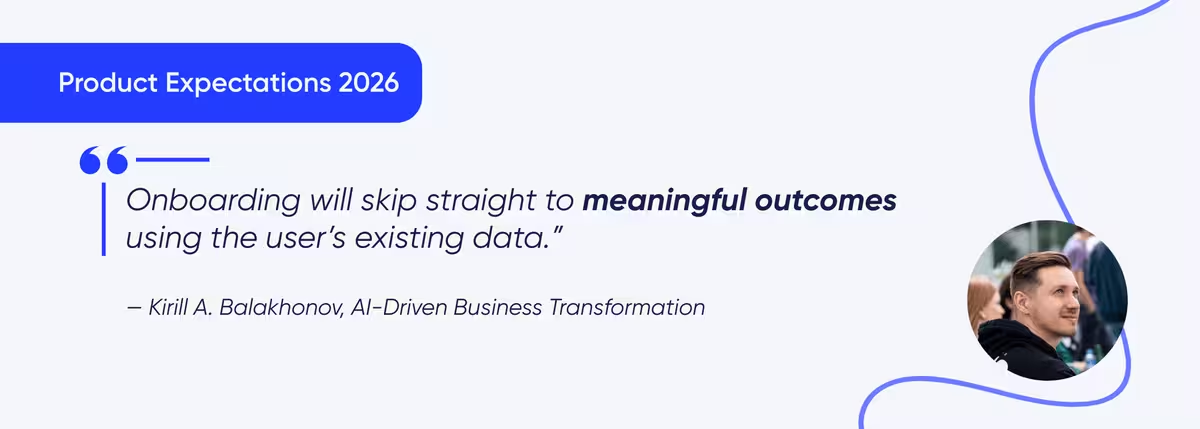
- Onboarding flows that skip straight to a meaningful outcome (a report, a configured integration, a first automation) using your existing data, instead of leaving you alone in an empty workspace.
- And in B2B, more collaborative onboarding: AI-assisted but still tightly coupled with CSMs / solution engineers, where every step is instrumented and optimized like a growth funnel, not a static checklist.
Asaf Levy — Product Leader
1 - Sustainability & self-serve
2 - Another tough year (Social Care UK) – regulator in chaos and budget cuts.
3 - (No third answer provided)
Marcelo Bomura Abe — Product & Development Leader
1 - I expect the product area to demonstrate more added value within software companies, specifically for companies that develop ERPs. There is too much bureaucracy in using agile ceremonies. Another aspect is that product marketing and product management will merge into a single role. Too many roles were created, making decisions overly complex and slow — we lost effectiveness.
2 - We already use AI to help POs and PMs describe user stories nearly perfectly. We created several notebooks combining documentation and source code, helping clarify questions about each product routine, since documentation is always incomplete and shallow. And the UX team uses Figma Make to create mockups using AI. Today, this serves as support; in the future, we expect AI to fully play the role of the PO, with humans only supervising and fine-tuning. Another point is that, with Agentic AI, we will have fewer operational interfaces and more monitoring interfaces.
3 - Agentic systems will monitor and assist new users in real time, even generating insights for the UX team. But it’s important to note that there will be fewer and fewer users and interfaces, as autonomous agents will operate the systems.
Julia Moretti — Product Owner / Manager
1 - I have no expectations, actually. But I’d love to see clearer designs.
2 - AI helping the discovery part would be awesome. How to create a better first version of the product focusing on the real value with the least effort.
3 -Smart onboarding (less instructions, lets focus on the main value)
Ana Carolina Borgonovi — Product Owner
1 - Automation Process: Companies will prioritize features that automate complex internal workflows and user tasks, focusing on increasing operational efficiency and reducing cost-to-serve, rather than purely on user acquisition.
2 - Deep Integration into the Product Development Cycle (APIs and SDKs): We will see fewer products developing their own AI models and more products leveraging specialized AI APIs and SDKs for specific tasks (e.g., code generation, regulated sentiment analysis, data auditing). This will democratize the ability to create "smart" products, drastically accelerating the time-to-market for new features.
3 - Focus on the First Value Delivery (Aha! Moment): Instead of lengthy tutorials (tours), user onboarding will be a minimal and contextualized workflow, whose sole objective is to lead the user to their first successful result in the product (the Aha! Moment) as quickly as possible. Any friction that does not directly contribute to this goal will be eliminated.
Andressa Siegel — Head of Product and Design
1 - In 2026, I expect product work to shift from shipping features fast to designing true end-to-end experiences. With development becoming easier thanks to better tooling, code automation and faster iteration, releasing features won’t be the differentiator anymore. The real advantage will come from verticalized operations built on data, where companies treat the entire customer journey as a product. Instead of producing more features, teams will focus on reducing friction, integrating real workflows and delivering depth and clarity that actually move business outcomes.
2 - By 2026, AI will move beyond generic assistants and become personalized micro-agents that deeply understand each customer’s business. These agents will learn from every interaction, remember context, and adapt to the user’s current moment inside the product making decisions, resolving tasks and guiding next steps with precision. They won’t run on static decision trees, but on evolving knowledge structured around each client. This shift will create powerful stickiness: the more the agent learns about a customer, the harder it becomes to replace the product. The challenge for product teams will be designing trust, transparency and safe guardrails around these autonomous layers.
3 - In 2026, I expect onboarding to finally mature, especially in markets like Brazil, where most companies still struggle not only with new user onboarding but also with feature onboarding. With faster development cycles, the next step is making learning easier for the customer. I believe onboarding will become more personalized, adapting to the user’s level of knowledge instead of offering a one-size-fits-all flow. In domains like finance, this is critical: most people aren’t financially educated. Being able to offer an educational, step-by-step onboarding for beginners and a streamlined, advanced version for experienced users would be a huge leap forward.
Keerthi Chandra Sekaren — Product Owner
1 - Right now there's a hype on adding AI to existing solutions but I think that'll slow down and there would be more focus on AI assisted solutions where product is built with a lot more help from AI.
2 - I expect AI to get a lot better at everything we do today in product. How much better will really depend on how much the tech advances.
3 - For consumer products, I think the expectations for user onboarding is going to become higher while for enterprise products, it'll remain human assisted until it gets to the end user experience.
Cristiano Valverde — Head of Product
1 - Excluding solely AI-based innovations, I expect to see RWA Tokenization, on/off-ramp global payments, and interoperable marketplaces.
2 - From product perspective, every product that embraces AI will have to make it in a very customized way to make sure it doesn’t end up in the common framework of the AI projects in terms of generic UX/UI and in terms of superficial/limited applicability.
3 - It should be divided by centralized onboarding and decentralized onboarding just for a start. Obviously it would bring consequences that would need a tailored approach.
Anaïs Moulin — Product Owner @ Ippon Technologies
1 - The Sustainability as a core product requirement : Regulations and customer expectations will push product teams to integrate energy efficiency, carbon transparency, and durability into product decisions. Sustainability KPIs will become part of product success metrics.
2 - I expect AI to accelerate : user research synthesis, opportunity mapping, early prototyping, experiment simulation, backlog grooming and prioritization assistance.
3 - That the onboarding will no longer be a static sequence, it will adapt automatically to : user intent inferred from early actions, skill level, industry, past behaviors or imported data…
Marcos de Melo — Head of Product & Growth
1 - In the SaaS space, we’ve reached a maturity threshold. Now that competition is fiercer, I expect to see differentiation happening in the fundamentals: reputation, cost efficiency, and velocity.
In healthtech specifically, I see two strong trends gaining traction: the rise of embedded finance as part of the care journey, and major advances in conversational cloud solutions that will redefine patient engagement and operational workflows.
2 - AI in 2026 sounds like a crazy race
My informed guess is operational efficiency and agentic AI (specialized in very specific JBTD)
3 - Onboarding is a forever job with very little to show when poorly executed, (executive levels have a hard time grasping the value of incremental % changes to activation rates IMO) real opportunity lies in better automated and personalized flows powered by AI
Ketlin Barbon — Product Owner
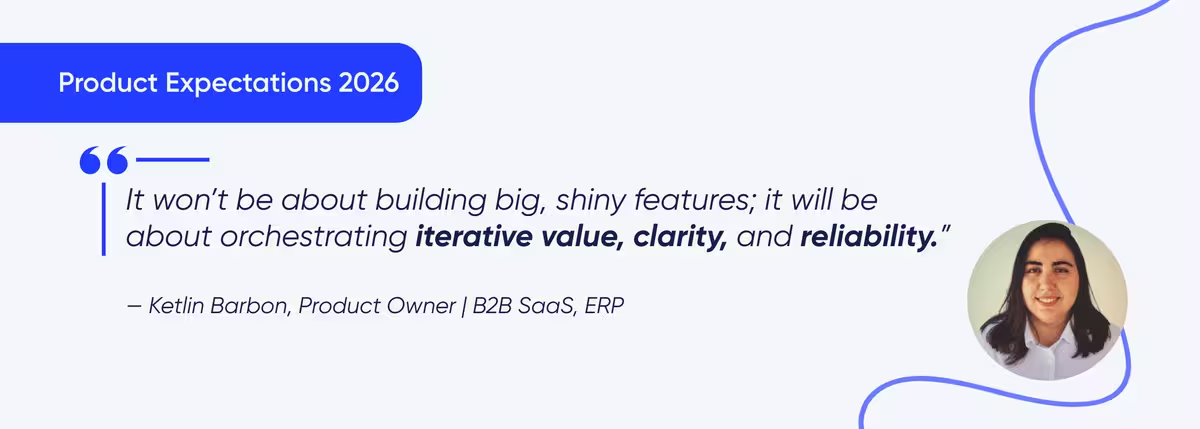
1 - In 2026, I expect the product field to shift toward a more integrated model where regulation, operations, and customer experience stop being independent layers and become a single product ecosystem. Especially in sectors like finance and telecom taxation, product work will increasingly revolve around bridging compliance, operational flows, and usability with precision. Teams that used to run on intuition or scattered priorities will move toward structured governance, continuous discovery, shorter feedback loops, and release cycles that deliver tangible impact fast. It won’t be about building big, shiny features,it will be about orchestrating iterative value, clarity, and reliability.
2 - When it comes to AI, I see 2026 as the year when AI stops being a “nice-to-have” and becomes the baseline for every serious product. Instead of generative-text fireworks, we’ll see AI acting as an operational copilot, detecting inconsistencies, preventing errors before they happen, and enabling real-time decision support in areas that depend heavily on accuracy, like tax documents, financial flows, or regulations that change frequently. Internally, AI will also become a force multiplier for product teams, reducing time spent on documentation, alignment, or manual analysis, and allowing POs to focus more on strategy, prioritization, and communicating value. The competitive edge won’t come from having AI, but from how deeply the product embeds intelligence into its core flows.
3 - For user onboarding, the shift will be equally significant. Onboarding won’t be a sequence of steps anymore, it will be a personalized, adaptive experience that reacts to the user's context, maturity, and goals. Instead of teaching people where to click, products will guide them toward the outcome they are trying to achieve, learning from behavior and tailoring the journey along the way. Onboarding will also become continuous rather than front-loaded; as new features roll out, users will receive contextual micro-guidance that fits seamlessly into their daily workflow. The best products will onboard not just the user, but the user’s real-world needs.
Karine Palacios — Chief Product Officer
1 - I believe Product Management is slightly narrowing at the moment in the Tech sector at least, with more focus on product development and tech innovation and where the other Ps are progressively moving to product Marketing functions or business dev and channel management functions. In Tech, the unified 5 Ps strategy is not really the norm.
2 - Product Management is focusing on providing inputs and overseeing the Agile development process more than sales enablement, commercial launches, or pricing strategies. AI is accelerating competitive analysis, SOR writing, backlog management, new features demands management, user story writing. UX design, LLD, dev, Product alpha testing, beta programme feedback analysis and management, QA… the whole product development life cycle.
3 - In terms of deployment and user onboarding I expect to see a move to real time guided user onboarding where AI Agents guide the user step by step in real time and dynamically to adopt and use the products.
Mariagda Grosso Botega — Head of Products
1 - I expect Product teams to evolve toward a much more integrated and cross-functional way of working. Instead of focusing on isolated feature delivery, the trend will be building connected ecosystems — products that talk to each other, reduce operational friction and create end-to-end experiences.
I also see a stronger emphasis on scalability and product governance: clearer decision frameworks, better alignment between business, tech and data, and more discipline around prioritization and long-term product health. In short, less “shipping for the sake of shipping” and more intentional value creation.
2 - For me, AI in 2026 becomes part of the backbone of product work, not a separate topic.
I expect AI to support discovery with faster insights, opportunity mapping and behavioral predictions. On the delivery side, AI will help teams build more efficiently — spotting issues earlier, automating repetitive tasks, and enabling faster iteration.
From a user perspective, AI will make experiences more contextual and intuitive, adapting flows in real time. Product Managers will spend less time writing specs and more time framing problems, shaping strategy and ensuring that AI is applied responsibly and transparently.
3 - I believe onboarding will become increasingly adaptive. Instead of long tutorials or linear flows, products will guide users only when it makes sense — based on their behavior, their context and their level of familiarity.
I also see onboarding blending with personalization and identity verification in a more seamless way. Users won’t feel like they’re going through “steps”; the product will simply know when to simplify, when to teach, and when to get out of the way.
Above all, onboarding will be shorter, more intelligent and deeply tied to delivering value faster.
Felipe Camargo — Digital Product Leader
1 - For me, it’s almost impossible to disconnect AI from product trends. I can already see emerging practices such as deeply data-driven decisions and insights, and large-scale experimentation powered by vibe-coding solutions.
Another AI-driven trend is the shift toward smaller engineering teams and smaller squads.
I also see engineers becoming much closer to product decisions.
2 - Every Product Manager must understand the fundamentals of AI and be able to generate test versions of product concepts using AI and vibe-coding.
Launches and feature development will be accelerated at scale.
3 - ChatGPT with browsing capabilities may change the way we operate products today.
We may even find new customer segments on large AIs and build applications inside these AI ecosystems.
Kylie Sirico — Senior Product Manager & AI Product Instructor
1 - We are reaching a point where product teams will need to clean up the work created during the AI prototyping rush. I expect a shift toward higher standards around data integrity, better evaluation frameworks, and structured experimentation. This cleanup phase is going to separate teams that built quickly from teams that built sustainably.
I also see more pressure on product teams to manage opt-in training, model transparency, and how user data is applied. It becomes part of the product experience, not just an engineering topic.
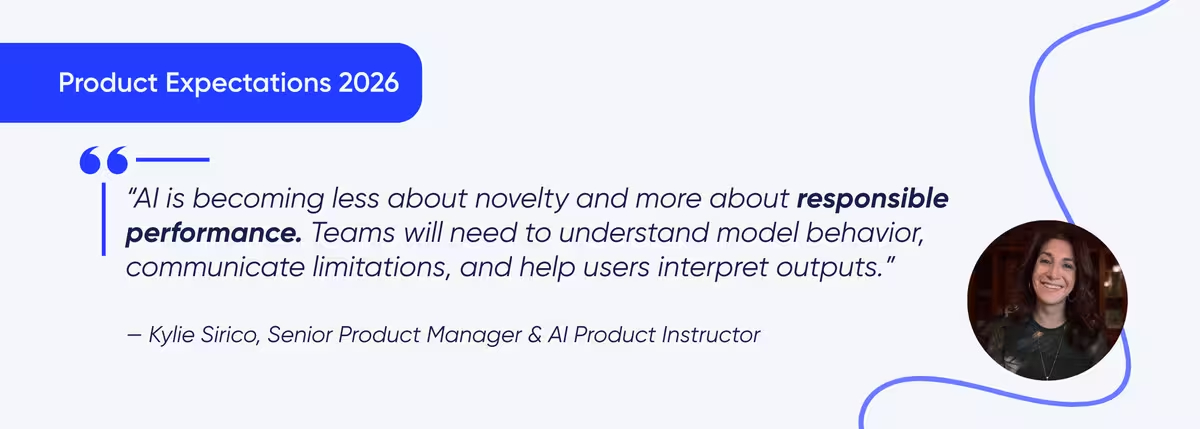
2 - AI is becoming less about novelty and more about responsible performance. I expect regulations to take a stronger role in how we design and train models. Product teams will need to understand model behavior, how to communicate limitations, and how to help users interpret AI outputs.
I am already seeing early signals from major players around ranking factors tied to AI quality. This will influence how teams evaluate and ship new AI features.
3 - Velocity is increasing, so onboarding needs to keep pace. For enterprise, I see onboarding expanding into customer documentation and the way users enter a workflow rather than a classic tutorial.
For AI products specifically, onboarding will need to teach users how to get better responses, especially beginners in a particular domain. We will see onboarding patterns that help users improve their inputs, understand system expectations, and build trust with the agent. That becomes part of the retention strategy.
Anonymous Contributor — Head of Product Delivery
1 - Product folk are building and deploying prototypes to production for customers to learn faster. With new and intuitive prototyping tools and seamless integrations, the traditional SDLC should take on a completely different shape.
2 - Do 80% of what my job was 3 years ago without my direct input, allowing time for strategy refinement and talking to customers.
3 - Don’t just give a user a great experience in my platform. Help me build a full picture of who they are so I can tailor an experience just for them using my AI features.

.png)