


.svg)
.svg)
.svg)
.svg)



.svg)




.svg)
.svg)


The SaaS market has always been competitive. There have always been early adopters and tech enthusiasts, just as there have always been those who are skeptical about trying new tools, who prefer their legacy software they’ve learnt how to use once many years ago…
What has changed in recent years is the speed at which new tools (or features and use cases within already existing tools) emerge due to AI, and in response, the speed at which people try out new tools.
So, if you’re an AI-first company, released some AI-powered features, or planning to release; in this article we talk about how users respond to AI products/features, what the traditional adoption curve looks like in regards to AI adoption, and how should you plan your customer communication, user onboarding, and feature promotion efforts specifically for users that land on different parts of the AI adoption curve.
Let’s get started!
TL;DR
- The product adoption curve, based on Rogers' diffusion of innovations, maps five personas, Innovators, Early Adopters, Early Majority, Late Majority, and Laggards, and how each reacts to new technology.
- All five personas already exist inside your own user base, no matter what stage your product is at in the market overall, and you can apply the curve at the level of your target market or even individual features.
- AI adoption is moving fast: per McKinsey's 2026 survey, 89% of companies use AI in at least one function, though specialized AI tools (like most SaaS AI features) still lag behind chatbots in deep adoption.
- Each persona needs a different approach: Innovators want to be heard, Early Adopters want proof and context, Early Majority want polish and peer validation, Late Majority want low-risk defaults, and Laggards want minimal disruption and human support.
- Tailoring your onboarding, communication, and feature promotion by persona drives higher and deeper AI feature adoption across all adoption personas.
What Is the Product Adoption Curve, Really?
The product adoption curve maps out different people's tendencies to react to new technologies, showing how quickly they experiment with a new product or tool and/or adopt it. It's not exclusively a SaaS concept, more broadly, it's used to describe the adoption rate of technologies like the internet, smartphones, computers, and electric vehicles. But since the curve theorizes how the public reacts to new developments in industry and technology, we often apply it to SaaS as well.
As AI, and GenAI in particular, became the topic on everyone's mind, the adoption rate of AI capabilities and products has closely mirrored the personas that correspond to each group in the adoption curve.
The product adoption curve is part of Everett Rogers’ theory called the diffusion of innovations. That’s why it’s also called the innovation adoption curve, due to where and how Rogers theorizes it. Rogers defines the “diffusion” as the process by which innovations and new technologies are communicated among the public.
According to Rogers, there are 5 different types of reactions to new tech, or adoption personas, we can say. These are:
- Innovators (2.5% of market)
- Early Adopters (13.5% of market)
- Early Majority (34% of market)
- Late Majority (34% of market)
- Laggards (16% of market)
If a new product successfully goes through the entire diffusion process (starting with innovators, moving to early adopters and the early majority, then reaching the late majority and finally the laggards) it means the product or technology has reached its fullest market value and saturation.
Here is how the product adoption curve (or innovation adoption curve, in other words) looks:
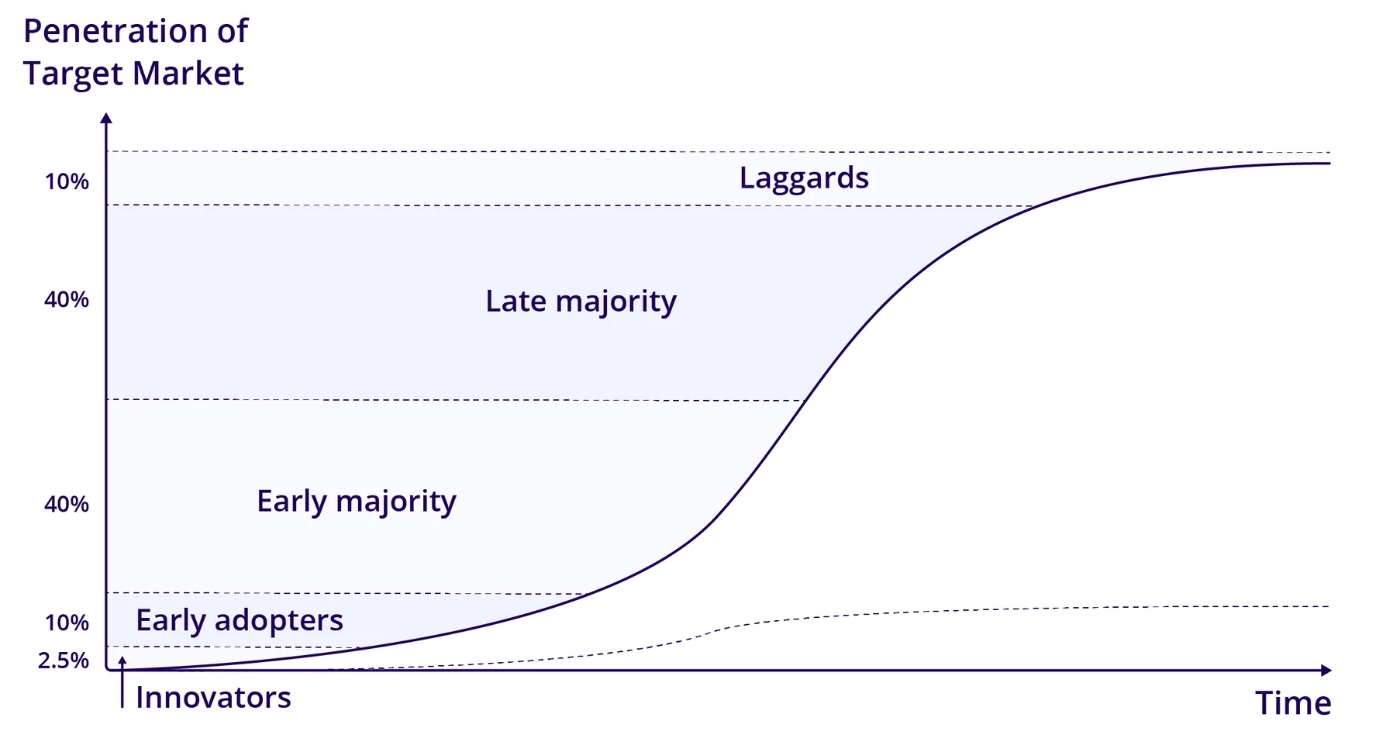
As you can see, the adoption rate starts slow with the innovators and early adopters; however, it starts to gain real momentum with the early majority. With the late majority, the adoption rate reaches its peak and then it slows again with the laggards.
One thing worth noting here is that many technologies and products never reach peak adoption or market saturation. Good examples of products and technologies that (almost) do are general consumer technologies like cell phones and laptops, or technologies whose adoption is enforced by regulation, like electric vehicles in some European markets.
⚠️ For SaaS products, while a few, like Microsoft 365, are in their late majority phase, many SaaS companies and products are still in the early stages of adoption.
So, going from one phase to the next, jumping from early adopter to early majority, for example, takes a lot of time, actually. Many products cannot cross what’s called “The Chasm” separating early adopters from early majority.
Innovators are visionaries who feel excited about new developments, who follow emerging trends and ideas, and who await new tech and products even before they hit the market. Early adopters are tech enthusiasts who also follow new developments, but react a little later than innovators; to be an innovator, one often needs early access to products, or even to be involved in the process of developing these technologies.
The early majority, though, are pragmatists who are open to new products provided that enough people have experimented with it, polished the experience, smoothed the rough edges, and proved value.
Geoffrey A. Moore, in his book Crossing the Chasm, explains that a tech company needs to build enough momentum to cross the chasm between the early adopters and early majority, and to turn their product into the de facto solution.
We’ll talk more about how to address the pragmatist early majority when the time comes.
💡 There’s one last thing worth discussing before closing this section, which is that you can look at your adoption rates on a micro level, too. We've said that on the macro market level, products move across the adoption curve at a very slow rate, with many staying stuck between innovators and early adopters. However, while these personas might seem like a small portion of the overall market, there are actually a lot of users there.
So it's fine, really, to stay in the innovators stage, in the big picture...
Plus, you can define your own "market," and your own pool of innovators, early adopters, early majority, late majority, and laggards, in a way. This means, for example, that your initial target market could be startups in the US with small product teams made up mostly of non-technical members, aside from the developers themselves, who are already busy building the actual product.
This also means your innovators and early adopters don't have to be "tech people" in the traditional sense. They just need to be the more experimental, forward-leaning members of the target market you've defined for yourself. For a startup like the one above, your innovators might simply be the non-technical founders or team members eager to try new tools.
So, what the product adoption curve, the S-curve, should tell you is the ways people approach new tools. You might be in the innovators stage of your own adoption curve, but there will be people among your users who are laggards, or late majority users. There will be tech enthusiasts and innovators trying out your SaaS product and bringing it to their non-tech-savvy team members or friends.
Thus, the product adoption curve actually gives you insight into existing user personas in the market, which is a great place to start building your own user personas.
Additionally, you can look at the feature adoption curve among your existing customers and users. Let's say you have three core features that all your users rely on. For a time-tracking tool like Toggl Track, for example, one of those could be time tracking via the browser extension. But you also have other features besides those core three, or you've just released a new one, with Toggl Track, that could be time-off management or invoicing. You can track and monitor the adoption of those features via the same curve. Aligning your communications, onboarding, announcements, and promotion of those features with the adoption curve personas, and how they relate to and react to new ideas and technology in general, can help you increase your adoption rates.
How do AI Products and Features Fit into The Product Adoption Curve?
AI-powered products and services (both generative AI and agentic AI) have entered people's workflows and daily lives very quickly. One can even argue that AI technology (at least in SaaS, in one form or another) reached its peak and hovers around the late majority in the adoption curve. According to McKinsey's The State of AI in 2026 survey, 89% of companies now use AI in at least one business function, up from around 50% in 2020 and 55% in 2023. In early-to-mid 2024, that adoption rate jumped to 72%, with the LLM APIs and MCPs –a.k.a. the Agentic AI era.
But of course, these statistics reflect minimal AI utilization in at least one business function.
If we look at changes in adoption depth, meaning what percentage of these AI adopters are only experimenting with the capabilities versus looking for ways to incorporate more AI into their workflows, we see that in 2025, 38% of companies using AI in at least one business function were at the experimentation stage of their journey, with 30% piloting and 38% scaling for more use cases. In 2026, McKinsey's data shows a decrease in the experimentation phase and an increase in the piloting and scaling phases, meaning many companies moved on from experimentation, and even piloting, to the next stage: scaling. According to the 2026 survey, only 22% of companies using AI in their operations are in the experimentation stage, with 34% in the piloting stage and 44% already in the scaling stage.
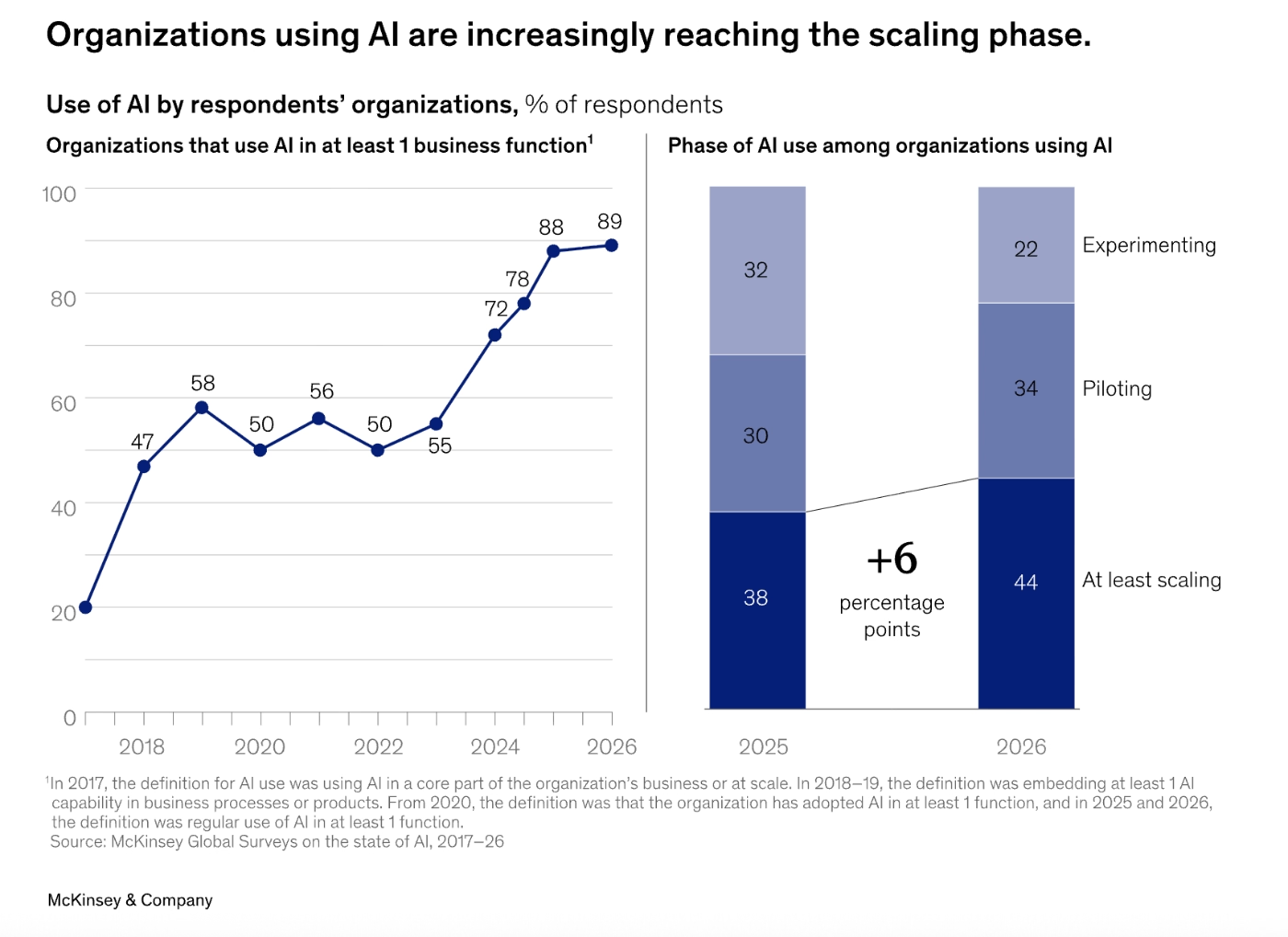
These adoption rates provide a general overview of AI technology adoption across different industries, organization sizes, and, of course, different AI tools. This means there can be differences in adoption tendencies and scaling efforts among companies and industries.
And there are.
👉🏻 Larger companies and enterprises move from the experimentation phase to deep adoption and scaling much faster than smaller companies, the data shows. According to McKinsey, 54% of survey respondents from organizations with at least $1 billion in annual revenue report scaling AI across the enterprise, compared with one-third of those from smaller organizations.
This is actually an interesting stat, since the bigger an organization is, the harder it generally tends to be to move fast on any change to the tech stack, due to reasons like larger team sizes, more complex contract requirements and negotiation processes, and a heavier workflow-migration load. Whereas with smaller teams and organizations, there tend to be fewer people to onboard and shorter, less complex contract negotiations, even if the workflow migration itself isn't necessarily any simpler.
However, with many AI tools coming with product-led, self-serve, pay-as-you-go pricing models, workflows accessible even to non-technical users, automated migration processes that complete tasks within minutes, if not seconds, and most importantly many companies' top-down AI adoption policies and "tokenmaxxing" trends, this stat starts to make sense.
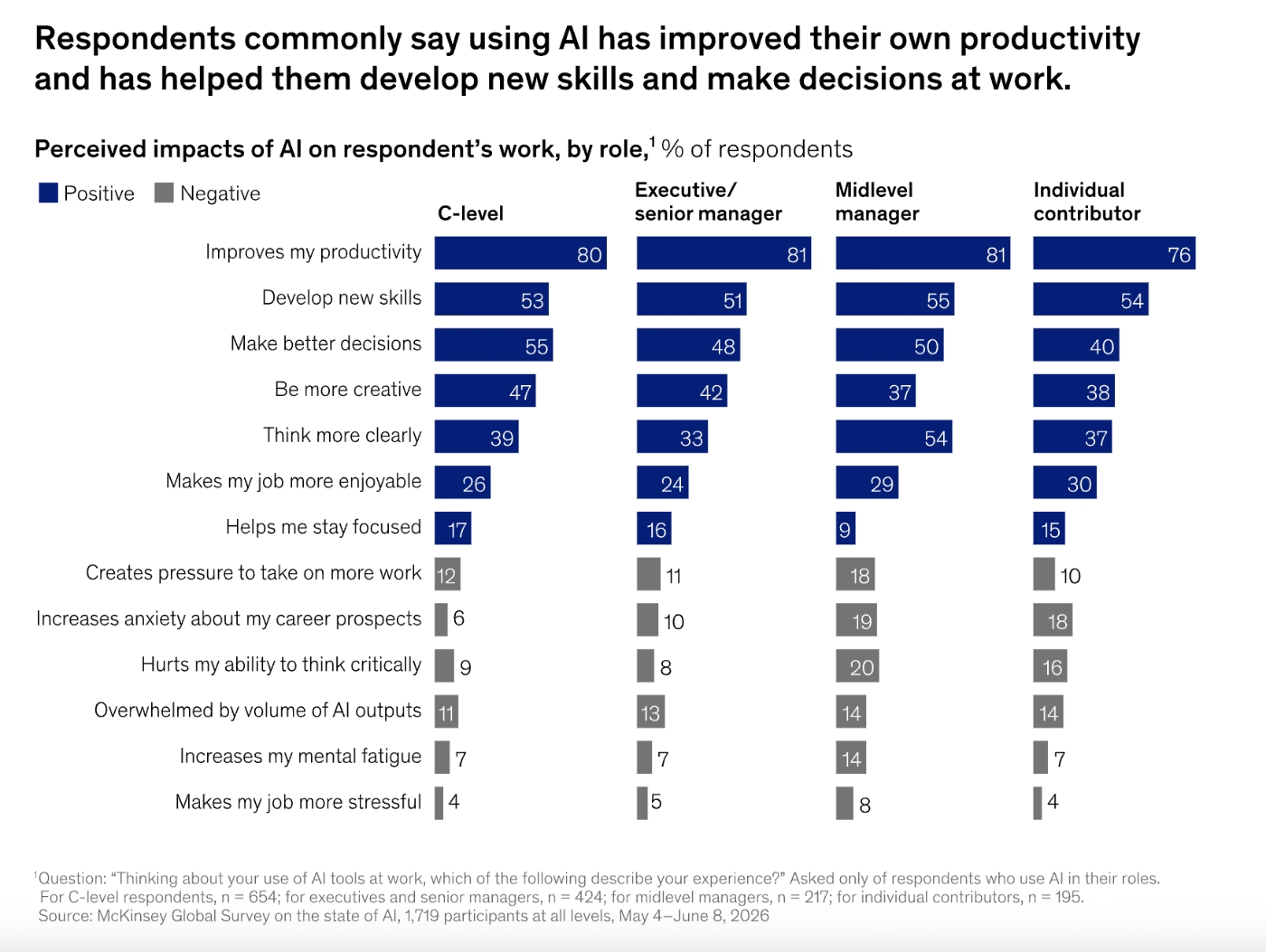
McKinsey's survey also shows how expectations around the potential advantages and efficiency of AI tools change across C-levels, executives, and individual team members. While the gap varies by attribute, there's an overall tendency to attribute more productivity, creativity, and efficiency to AI tools among higher-level managers and executives than among individual contributors and team members.
For example, while 55% of C-levels attribute better decision-making to AI tools, that number drops to 40% among individual contributors. Or, while 47% of C-levels attribute improved creativity to AI tools, only 38% of individual team members say the same.
While these are certainly not low numbers, and still show great adoption and high perceived value at the individual level as well, one cannot deny that C-levels' and senior managers' higher expectations and perceived value of AI tools can impact adoption of these tools in bigger organizations, where there's a more pronounced team structure and top-down decision-making.
Here are a few more ways perceptions of AI tools differ across roles in companies:
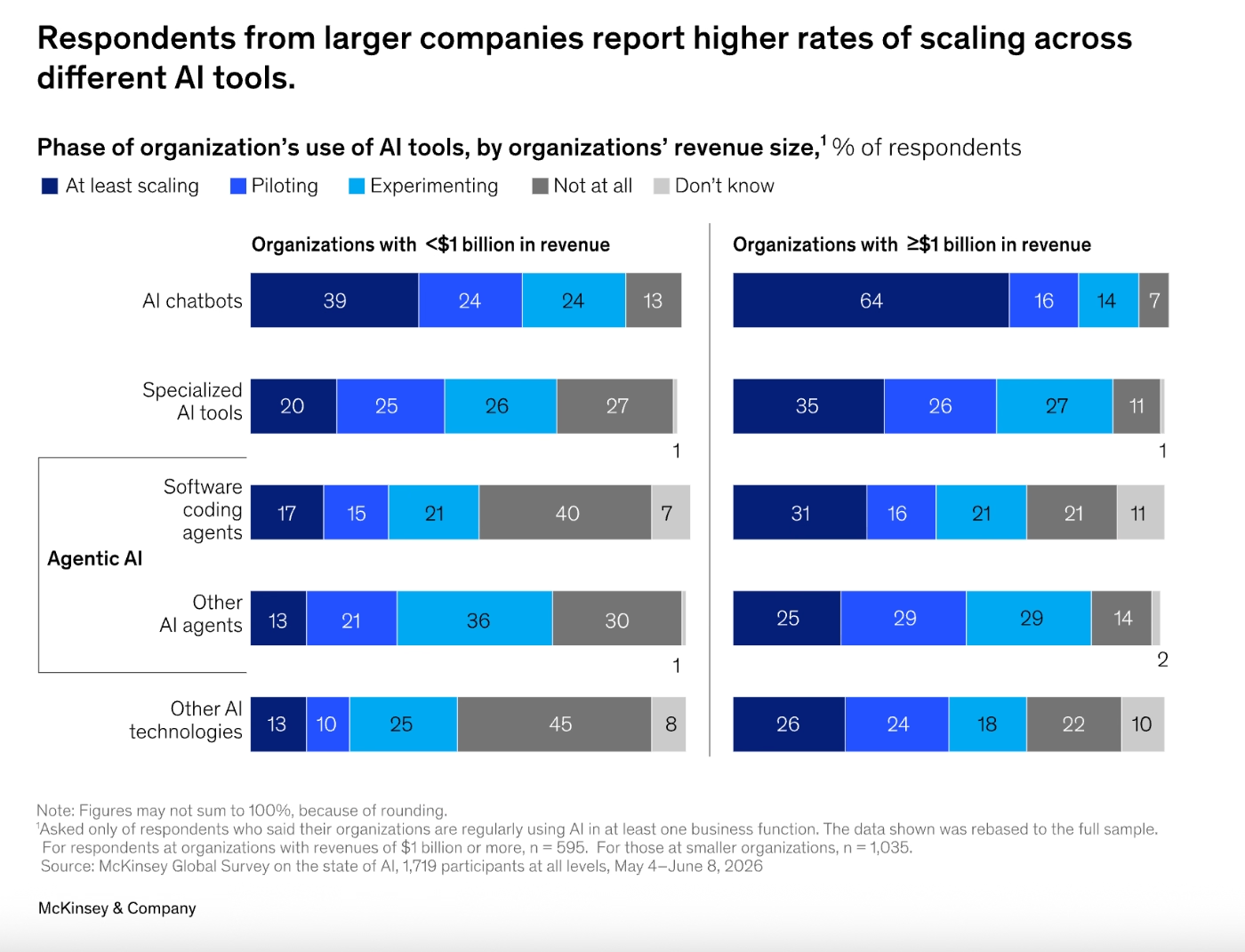
👉🏻 Additionally, the level of adoption (or experimentation) changes across different AI technologies and products. AI chatbots, for example, have the highest deep-adoption rates among both larger and smaller organizations, with 64% of larger companies already scaling their usage of AI chatbots, only 14% of them just starting to experiment with chatbots, and only 7% not using AI chatbots at all. Among smaller organizations, the gap between adoption stages is narrower, with 39% already scaling their AI chatbot adoption, 24% just dipping their toes in and experimenting, and 13% still not using any AI chatbot.
When it comes to specialized AI tools (where your AI product and/or AI-powered features probably land), we see a steep drop in deep adoption, especially among larger enterprises. While 35% of large enterprises and companies scale their specialized AI tool adoption in 2026, 27% of them are just experimenting with such tools, and 11% are not using any specialized AI tools at all. For smaller organizations, the scaling number is around 20%, and 27% are not using any specialized AI tools at all.
With agentic AI tools (like software coding agents), adoption rates run a bit lower, with 31% of large organizations scaling their efforts and only 17% of smaller organizations doing the same. However, across both smaller and larger organizations, we see around 21% experimenting and around 15% piloting different use cases and workflows.
McKinsey also found out that 32% of respondents report their organizations have decided against purchasing at least one software product or feature because they were able to build the functionality in-house using agentic coding tools. So, in the following years (or even months, really), as adoption of agentic AI tools increases, we might start to see a decrease in the adoption of specialized AI tools.
Technology and SaaS companies lead the way in going in-house with agentic AI instead of using specialized AI tools, at 41%, followed by healthcare at 39%.
⚠️ Before closing this section, we need to note that McKinsey's criteria for "larger" and "smaller" organizations might skew the numbers, as setting the bar at $1 billion in ARR is very high, with a lot of startups, scaleups, mid-level companies, and even some enterprises bundling together into the "smaller organizations" group. Some SaaS companies with $1 billion+ in ARR include Shopify, HubSpot, Figma, and Monday.com. However, some "big" names like Asana, Webflow, or Zapier still fall under that $1 billion ARR threshold.
So, you might want to take the numbers McKinsey provides with a grain of salt, as depending on your own customer market and pool, adoption trends might look different from what this survey suggests.
How Each Adoption Persona Reacts to AI Features (and How to Win Them Over)
We've said that you should look at the product adoption curve with an eye toward understanding different user behaviors and approaches to new tools and products, since you already have all of them among your own user base and customer pool, no matter what part of the S-curve you're at in your own market-penetration journey.
You have users who leave feature requests in your inbox, trying to get involved in the product development process; who enroll in beta testing for your new features and don't mind providing detailed feedback; who shy away from new feature announcements and stick to core capabilities until they're won over by positive word-of-mouth about that feature.
Now, with all the AI adoption and perceived-value stats we've just gone over in mind, let's dig into what all this means for individual users and the different personas that correspond to each stage of the adoption curve.
Innovators: The Tech Visionaries Requesting AI Features and New Use Cases
Innovators correspond to a mere 2.5% of the total market on the adoption curve, so it’s only normal that you probably only have few of them among your own users.
Having few is the dream for many companies and product teams, actually.
Anyway.
Innovators tend to follow the developments in the tech world; they often like trying out new tools, even reading release notes of big tech companies as if they were fun blogs. They’re the ones who find workarounds all on their own if they want to do something with your tool but your current capabilities do not really work in that way.
Innovators also tend to be the ones who find your product, bring it to their team, and become the unofficial rep and onboarding specialist.
You don’t need to put much effort into convincing them to try a new AI feature/capability you release. A simple announcement, maybe an email, an in-app popup, a handy tooltip in a relevant place on the UI, or a banner with a CTA that takes them to the feature will be enough to get their attention and encourage them to interact with the new feature.
While it might not be hard to bring innovator-type users to experiment with your AI product/feature, it can be hard to retain them.
Why? Well…
- Innovators tend to try out multiple products, so, they tend to be strong comparativists. They know the pros and cons of many of your competitors and won’t be staying with the first tool they try out. This can be good or bad for you, depending on the circumstances.
- Innovators tend to expect a decent amount of freedom and flexibility with the tools they use. This can include more customization capabilities, API access, or custom integrations.
- Being an “innovator”-type user doesn’t mean they know everything. Innovators still need onboarding or an introduction to a new capability, no matter how excited they are for that capability or whether or not they were the one who requested it. Sure, they might not need the same detailed tour as your laggard-type users, but they were not there when your product team designed the workflow, were they? 👀
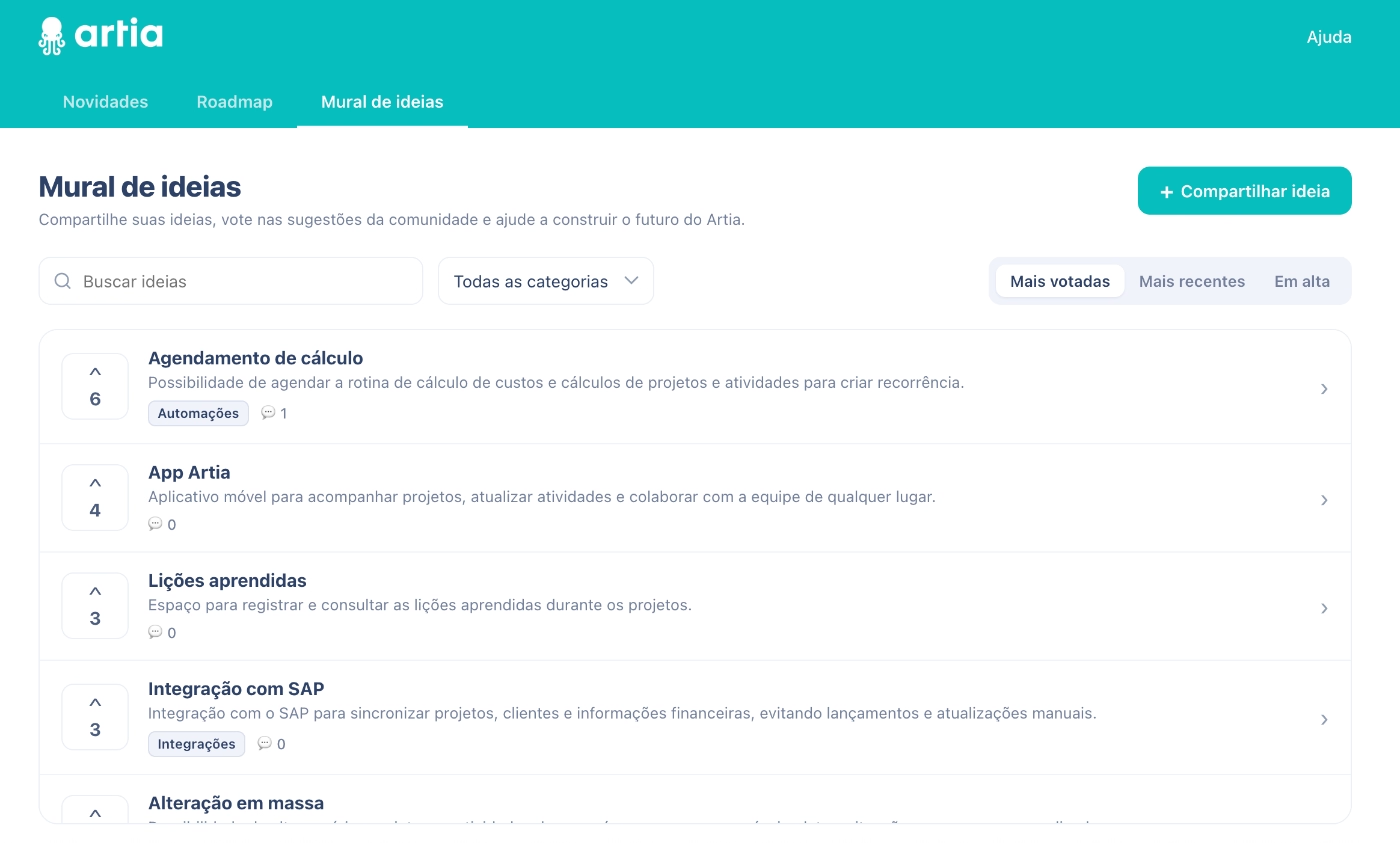
- Innovators need to know their needs are heard, and their experiences/expectations are prioritized in product development processes. This means opening 2-way communication channels, collecting feedback and feature requests/suggestions, and then actually acting on the user insights you gathered. You can create feature request boards and public changelogs for that, as well as in-app surveys and feedback widgets.
‼️ If there was only one thing you could do to draw the attention of innovator-type users (and retain them), it would be: Showing how user-centric and open to feedback you are by allowing your users to reach out to you to leave their suggestions and communicate their evolving expectations and needs via (preferably several) channels like feature request boards, interactive changelogs with upvoting capabilities, or always accessible in-app feedback forms and surveys.
Early Adopters: The Beta Testers Who Give You Detailed Feedback on AI Features
You can think of your early adopters as users who engage with your new feature announcements, like banners, pop-ups, hotspots, or even the release notes on your product updates pages. Early adopters, too, do not require a lot of persuasion to check out a new AI capability. Oftentimes, they’ll be willing to try things out, enroll in your Beta testing runs, and provide feedback on their experience.
To drive strong adoption among early adopters, you need to communicate the unique selling points and use cases of your AI product or feature.
Because, yes, early adopters do not seek perfection or proven success of a product like majority-type users; however, they won’t jump to a new thing as easily as the innovator-type users.
Early adopter-type users require a clear understanding of the potential of a new AI tool, so, you need to work on your value proposition and how you communicate it to your customers if you want to win the early adopters among them.
For example, you can announce your new feature via a banner with a clickable CTA that takes the user to your release note/ feature announcement where you explain the new capability and its use cases in more detail, like this one here:

Or, you can announce it via a pop-up modal within your app, like this:
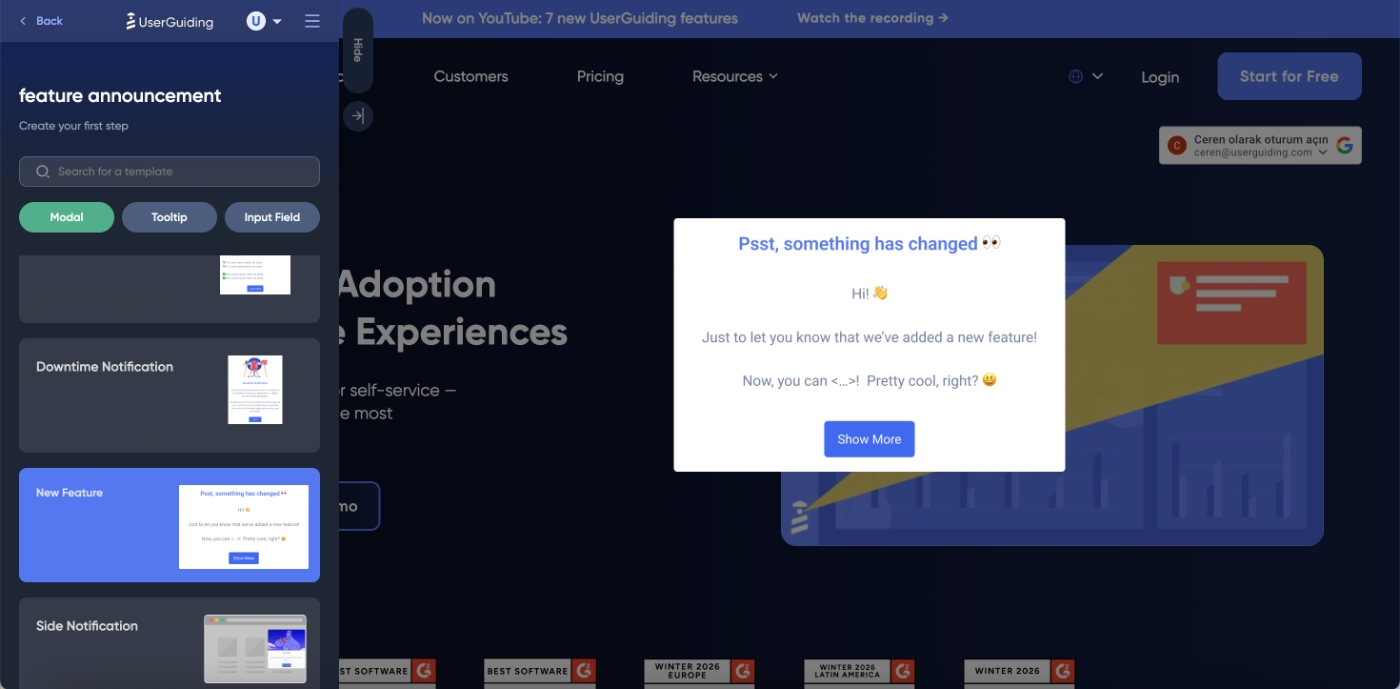
Once you get your early adopters on board and ready to try things out, you should also make sure to gather all the feedback and valuable insights you can from them. Their experiences will show you the areas where you can still develop your tool further, as well as what needs more simplification or contextualization.
Getting feedback from innovator-type users can sometimes be hard. Yes, they're good at providing a bunch of new feature ideas and suggestions; however, when it comes to feedback about improvements, it can be tricky to get it out of them.
Sometimes they just don't like something and switch to another tool; sometimes they know how to work around something that would upset average users, but it doesn't bother them; or sometimes they expect too much, more than is really relevant for the majority of your users.
With early adopters, however, you hit the sweet spot.
They still spend the time and energy to try things out, don't mind giving feedback (good or bad), and are somewhat willing to be involved in the development process. They also tend to represent the average user better than innovators do. So it's important that you follow up on their initial interaction with in-app surveys and feedback forms. If you're running a beta test, you can also reach out to users for more detailed feedback sessions and maybe set up an interview or send a longer feedback form.
‼️ If there was only one thing you could do to draw the attention of early adopter-type users (and retain them), it would be: Announcing your new feature/capability/tool contextually via banners, hotspots, pop-up modals, and release notes, as well as following up via in-app surveys to gather feedback.
Early Majority: The Users Who Need Polish and Peer Validation First
Unlike innovators and early adopters, the early majority aren't chasing the thrill of trying something new. They’re not against new tech or tools, they’re open to the idea of migrating from one tool to another, on paper.
However, they need more tangible proof than ideals and promises.
They need to see other similar companies or teams using the tool/feature. They need success stories, benchmarks, example outcomes, or at the very least, tailored materials (like guides and tutorials) and templates for their use cases and needs.
Other things the early majority users need before they'll commit to trying a new AI capability:
- A sense that the feature is polished and stable, not an experimental beta. Early majority users are far less forgiving of rough edges than innovators or early adopters.
- A value proposition that speaks directly to their workflow. Generic "look what AI can do" messaging won't land with the early majority, as they’re not the most experiment-for-the-sake-of-experiment type of users.
- Guided, structured onboarding. They won't dig around to discover a feature on their own the way an innovator might. Instead, they need the tool to be introduced to them, in context, and with a clear reason to try it out.
Here’s an example onboarding tutorial from Otter AI showcasing first how to record things and add notes in a recording, then, introducing their new AI capability, Otter Chat, and showing how to converse with a recording (using the example recording you’ve just recorded, actually!!) 👇🏻
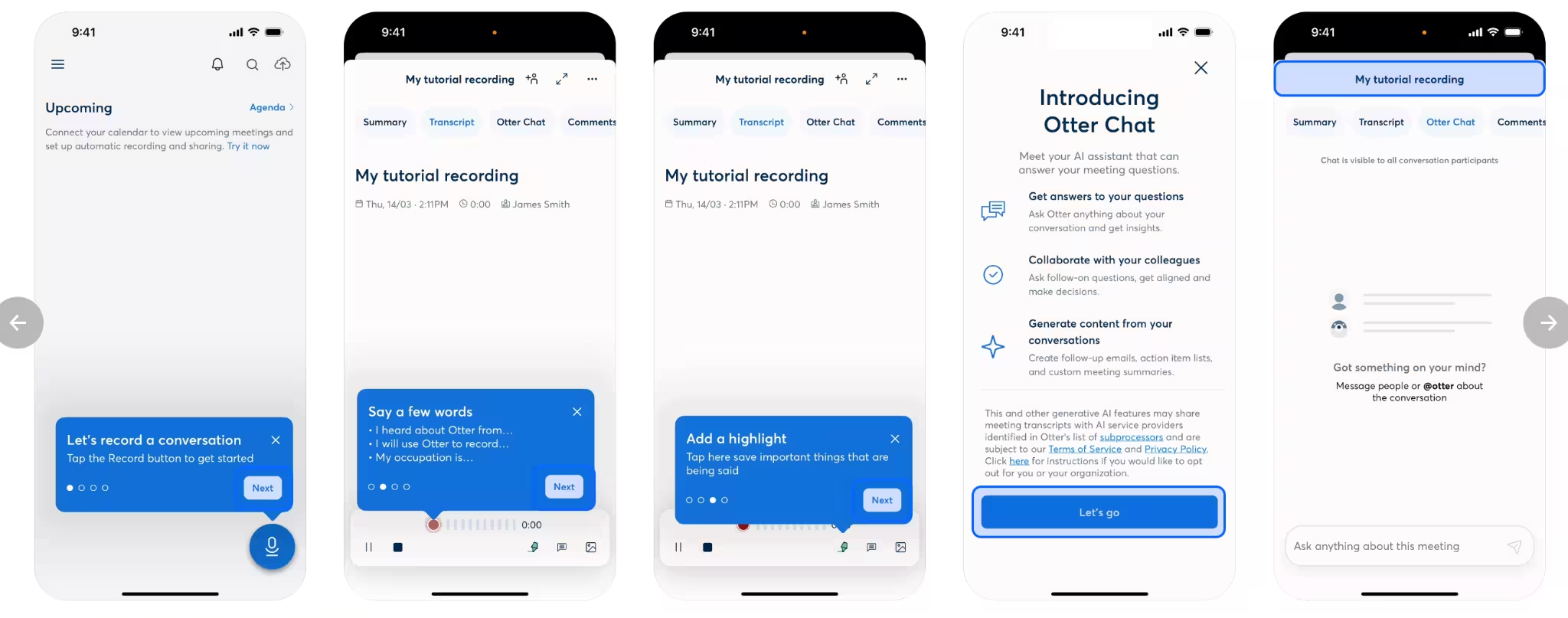
This is a good example to get inspired from, as Otter AI contextualizes its new AI feature/tool and not just announces it but also offers a list of clear use cases (like creating follow-up emails or custom meeting summaries) and an onboarding tutorial to make sure that the users experience some kind of value to help them understand the potential of the feature better.
Additionally, by introducing the new AI capability as part of a “natural” workflow (or alongside the core features within the initial onboarding flow) to the new users, Otter AI also ensures that the new AI capability is not understood or conceptualized as something complex, something advanced that new users will need to tackle later on (or not touch at all).
‼️ If there was only one thing you could do to draw the attention of early majority-type users (and retain them), it would be: Tailoring your value proposition for your new AI capability for users who have different personas and use cases. Here, you can also create personalized onboarding flows (checklists, tours, etc.) that showcase how the new capability/tool can be useful for a specific user role or segment.
Late Majority: The Skeptics Who Adopt AI Features Once Everyone Else Has
Okay, so, while early majority adopt because they've seen proof something works, the late majority adopt because not adopting basically starts to feel riskier than adopting.
This group is naturally skeptical of change, more risk-averse, and generally more comfortable sticking with what they already know, even if it's clunkier or less efficient. They're not swayed by feature announcements, case studies, or even peer testimonials in the way the early majority are. What actually moves them is pressure, as everyone else on their team is probably already using the AI feature or others have normalized it in the industry.
So, by the time late majority users show up, the decision has often already been made for them, either socially or organizationally.
Because of this, trying to "sell" late majority users on your AI feature the way you would an early adopter usually falls flat. What works better is lowering the perceived risk and effort to near zero. This means reassuring them the feature can be turned off anytime, explaining that the new thing doesn't affect their existing workflow, and making sure that they understand that this AI tool won't put their data or output at risk.
You also need to reduce the required effort and learning curve to adopt a tool.
You can, for example, create defaults and templates to make it easy and less intimidating to get started with your AI feature. Defaults and templates also help users understand the range of use cases for AI features, which is valuable since many late majority-type users are non-technical and not particularly interested in experimenting with new technology, so they might need extra inspiration on how to actually use it.
‼️ If there was only one thing you could do to draw the attention of late majority-type users (and retain them), it would be: Making the new capability feel like the safe, default, already-normalized choice, rather than something they need to be persuaded into. You can also default-enable the feature with easy opt-out, and reassure them around data privacy and control instead of trying to win them over with feature depth.
Laggards: Users Who Adopt AI Features Only When There's No Other Choice
Laggards tend to be deeply anchored in how they've always done things, skeptical of "new" for its own sake, and often distrustful of whoever's pushing the change, whether that's your product team, their own leadership, or the industry at large.
For laggards, the manual workaround, the spreadsheet, the old feature, isn't a limitation, really.
They just don’t see the need for any change, even if it could potentially make things a little better, smoother, or easier…
So they'll typically only move when the old way is no longer an option. For example, (as we saw in the McKinsey data) when their own organization has rolled out a top-down policy pushing AI adoption.
This means persuasion, proof, and even normalization (the tactics that work on early and late majority users) mostly won't move a laggard. What can actually help, however, is to:
- Offer real, human support. Laggards are far more likely to ask a person for help than to explore a feature on their own, so live chat, guided setup calls, or dedicated support resources matter more here than self-serve documentation.
- Avoid AI-specific framing altogether. Terms like "AI-powered" can read as unnecessary complexity or a reason for distrust to this group; framing the feature around the outcome it produces, not the technology behind it, tends to land better.
‼️ If there was only one thing you could do to draw the attention of laggard-type users (and retain them), it would be: Focusing on the outcome and ease of adoption rather than the technology itself, and keeping the human factor front and center in your communication, support, and onboarding. Rather than highlighting the tech behind your shiny AI feature, show them how it's simply doing, faster or easier, the same thing they were already doing by hand, without eliminating their role or completely upending their workflow.
How Do I Actually Know Which Adoption Persona My Users Are?
You don't need a formal survey to start segmenting users by adoption persona, as most of the signal is already sitting in your product engagement data.
You can look at…
- Time-to-first-use: Users who try a new AI feature within days of launch, before you've even fully announced it, are almost always innovators or early adopters. Users who only touch it after a wide announcement or repeated nudges tend to be early or late majority.
- Feature requests and feedback activity: Anyone proactively requesting features, joining betas, or leaving detailed feedback is likely an innovator or early adopter.
- Usage depth: Innovators and early adopters explore broadly (multiple features, advanced settings, integrations); early and late majority stick tightly to their core workflow.
- Response to nudges: If a user only adopts after repeated in-app prompts or a default-on rollout, that's a late majority signal. If they need human support or a hard deadline to switch, that's a laggard.
- Referral and advocacy behavior: Users who bring your tool to teammates, share it in communities, or act as informal "reps" within their team are usually innovators or early adopters, this ties back to that trait of theirs we mentioned earlier.
- Support ticket patterns: Innovators tend to file edge-case requests or push the tool in unintended ways; late majority and laggards more often file basic "how do I..." tickets or ask for a manual walkthrough instead of self-serving.
- Role and team context: Non-technical roles, larger teams, or more risk-averse departments (finance, legal, ops) skew toward late majority and laggard behavior, while smaller, scrappier teams or product-adjacent roles skew earlier on the curve. This is a proxy, not a rule, but it's a useful starting filter.
To Wrap Up…
The product adoption curve is everywhere, if you want to see it.
We live on the curve, really!
Joking aside, we've talked about different ways to interpret and analyze the product adoption curve in this article, starting with the traditional theory behind the diffusion of innovations and how it relates to market penetration, then discussing how we can look at different levels of it, from your own target market down to feature-level adoption.
We also talked specifically about the AI adoption curve, and how different user personas approach and perceive AI tools and features differently.
All in all, you're now up to date on current user behavior around AI tools (thanks, McKinsey!), and you have everything you need to know about the adoption curve, and are ready to use it for analyzing your users' behavior and tailoring your onboarding, communication, and support, for any feature or product, really, not just AI ones.
If you want to put these onboarding, support, and in-app communication strategies into practice, you can start your free trial with UserGuiding and create all the example guides, changelogs, feature request boards, surveys, tooltips, banners, and more that we've talked about in this article!
Frequently Asked Questions
What is the product adoption curve and why does it matter for SaaS?
The product adoption curve, based on Everett Rogers' diffusion of innovations theory, maps out how different people react to and adopt new technology, from innovators who jump on things immediately to laggards who hold out until they have no other choice. For SaaS specifically, it matters because your user base isn't one homogeneous group; you have all five of these personas sitting inside your product right now, each expecting a different kind of communication, onboarding, and proof before they'll actually adopt a feature.
Why do users try an AI feature but never really adopt it?
This usually comes down to the gap between curiosity and habit. A lot of users, especially innovators and early adopters, will click into a new AI feature simply because it's new, not because they've identified a real need for it yet. If you don't clearly show them a repeatable use case in that first interaction, or if you don't nudge the feature back into their workflow afterward, that one-time trial can fade out just as quickly as it started. To fix that, you can introduce the feature contextually when it’s relevant to the task a user’s already doing on the app, follow up with a nudge if they haven't come back to it within a few days, and show them exactly how to use it for a use case they have. You can also use templates and checklists to show the potential value of the feature to your users.
How do you measure product adoption beyond signups and trials?
You can look at feature-level metrics like time-to-first-use, how often the feature gets used after that first try (not just once), and whether usage is deepening over time or tapering off. Segmenting these numbers by persona is even more useful, since a low adoption rate can mean very different things depending on whether it's your early majority or your laggards holding back. Pairing this usage data with qualitative feedback (like in-app surveys or support tickets) rounds it out by telling you not just who adopted, but why or why not.

.png&w=3840&q=75)