

.svg)
.svg)
.svg)
.svg)



.svg)



.svg)
.svg)

If you've started looking for a way to guide users inside your product, WalkMe is probably one of the first names you came across. It's one of the oldest players in digital adoption and since 2024 it's part of SAP.
But being the best-known tool doesn't make it the right one for every team.
WalkMe was built for large enterprises rolling out internal software to thousands of employees. If you're a SaaS company trying to onboard and activate your own customers, you may be paying for, and learning to use, a lot of features you'll never need.
UserGuiding, on the other hand, is a no-code product adoption platform built for SaaS teams that want to launch onboarding, help content, and feedback flows without waiting on developers.
In this comparison, we'll go over what each tool does, where it shines, where it falls short, and how their pricing works, so you can decide which one fits your use case, team, and budget.
Let’s start!
TL;DR
- WalkMe is an enterprise digital adoption platform, owned by SAP since 2024. It has repositioned itself around enterprise AI adoption, workflow automation, and change management, with deep analytics, agentic AI features like the Action Bar, and SaaS spend tracking.
- UserGuiding is a no-code, all-in-one product adoption platform that covers the whole user journey, from onboarding to support, feedback, and product communication. It brings product tours, checklists, and tooltips together with surveys and NPS, a resource center, a knowledge base, an AI assistant, product updates, feature request boards, and public or private roadmaps, plus analytics and session replay.
- Setup: WalkMe usually needs dedicated admins or developers and a longer rollout. UserGuiding can be installed with a code snippet and built by non-technical teams.
- Pricing: WalkMe is quote-based with annual contracts, typically in the tens of thousands of dollars per year. UserGuiding has public and flexible pricing along with a free trial.
- Pick WalkMe if you're a large enterprise digitizing internal workflows.
- Pick UserGuiding if you want one tool to onboard, support, engage, and listen to your users, and keep them updated on what's coming next, without a big budget or engineering support.
WalkMe vs UserGuiding: An Overview of The Platforms
What is WalkMe?
WalkMe is a Digital Adoption Platform (DAP) that helps enterprises drive AI adoption, manage organizational change, and standardize how employees get work done across their existing software stack.
That said, it still offers in-app guidance and onboarding capabilities, too. The platform covers things like:
- Contextual AI assistance (Pinned, Proactive, and On-Demand AI)
- Workflow automation and analytics
- License optimization and AI/app usage discovery
- Employee training, simulations, and learning paths
- Product tours, walkthroughs, hotspots, tooltips, checklists
- NPS, CSAT, and in-app surveys
- Segmentation
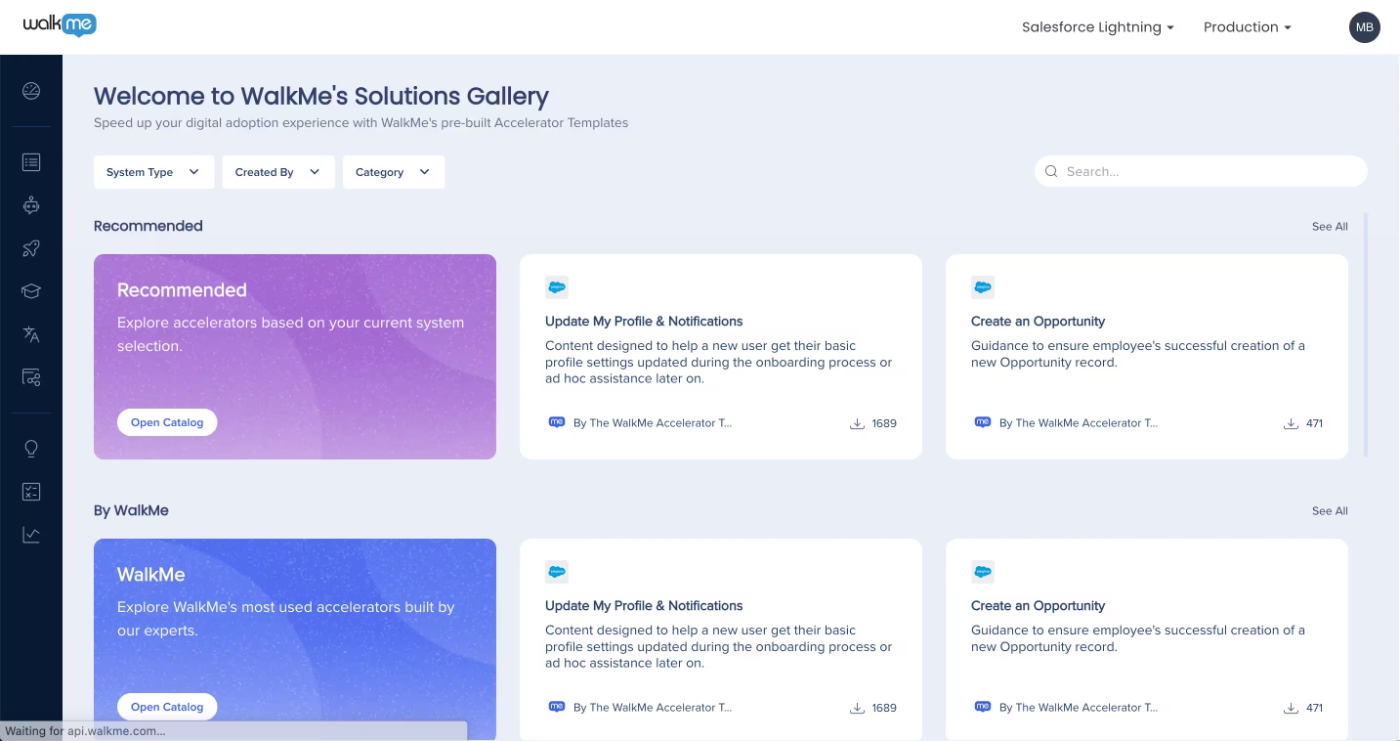
Want the full breakdown with visuals of the platform? Check out our detailed What is WalkMe guide 👈🏻
WalkMe Pros
WalkMe has many strengths, such as:
✅ Advanced analytics and reporting, now including AI-specific adoption tracking (AI Usage Dashboard, AI Insights) on top of the older workflow and form analytics
✅ Varied AI capabilities (conversational AI chatbots and agentic AI capabilities)
✅ Employee productivity tools, centralized in WalkMe Menu, with per-user memory and personalization built in
✅ License optimization and SaaS spend tracking
✅ Detailed segmentation and personalization capabilities
✅ Deep enterprise integrations, especially post-SAP (SuccessFactors, Ariba, SAP CX Sales Cloud, alongside Salesforce, ServiceNow, and Workday)
✅ An active community forum for peer-to-peer support
WalkMe Cons
❌ Very complex platform with a steep learning curve
❌ Overcrowded and difficult-to-navigate UI
❌ Lacks key product adoption features like knowledge bases, roadmaps, product updates pages, and user journeys. Feedback capabilities are thin, too
❌ Limited in-app announcement options
❌ Maintaining and updating materials over time is burdensome and time-consuming
❌ Support team can be hard to reach, and the self-serve help center is difficult to navigate
❌ It's really pricey, especially for small businesses, and the newer AI capabilities add another paywall on top of a base platform that's already priced by quote only
WalkMe Pricing
WalkMe doesn't publish its prices. Every plan is quote-based and sold on annual contracts. It's organized into two main plans:
- WalkMe for Employees: in-app guidance, workflow automation, employee productivity, and collaboration features.
- WalkMe for Customers: onboarding, content management, surveys, segmentation, and analytics.
On top of these, you can buy add-on bundles for AI capabilities.
Based on Vendr's purchase data, the average WalkMe contract is around $39,000 per year, and large deployments can go above $200,000.
In addition to these numbers, WalkMe comes with hidden costs, like implementation/ maintenance time and admin headcount/ training.
What is UserGuiding?
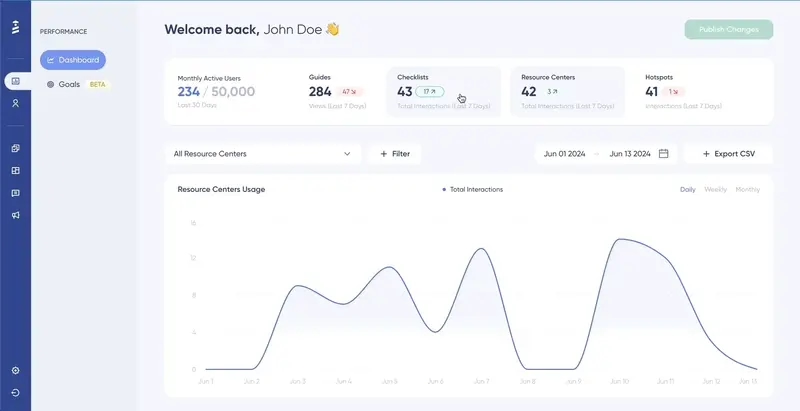
UserGuiding is a no-code, all-in-one product adoption solution for personalizing your in-app experiences and user communication, offering automated self-serve customer support, collecting customer feedback and feature requests, as well as announcing your product updates.
The platform’s features include:
- Product tours
- Tooltips and hotspots
- Banners
- Checklists
- Resource centers
- Surveys and NPS
- Knowledge bases
- Product updates
- AI assistants
- Analytics
- Session replay
- No-code event tracking
- MCP (Model Context Protocol)
- Custom alerts
- Feature request boards
- Public/Private product roadmaps
- Lighthouse AI (a conversational AI agent that lives inside the UserGuiding panel and allows you to ask questions about your materials and user segments)
UserGuiding Pros
✅ No-code setup that lets most teams publish their first guide on day one
✅ Low-maintenance flows that non-technical teams can update or replace in minutes
✅ All-in-one customer-facing stack (onboarding, help center, product updates, feedback, and roadmap in one tool instead of three or four)
✅ Transparent and scalable pricing with public plans, monthly billing options
✅ Built-in AI assistant, available from the Starter plan
✅ A large library of modern, use-case-oriented templates for in-app modals (from welcome screens to feature announcements) that are easy to customize
✅ Responsive support and customer success teams
UserGuiding Cons
❌ Not specifically built for employee-facing, cross-app adoption
❌ No IT-oriented features like SaaS spend management or an employee workstation hub
❌ Web-focused platform, so native mobile onboarding needs another tool
UserGuiding Pricing
UserGuiding has three plans, all priced by monthly active users (MAU):
UserGuiding uses a flexible and scalable MAU-based pricing model. These starting prices are for up to 2,000 MAUs, and as your user base grows, these prices reasonably scale with you.
UserGuiding also offers a monthly billing option.
Should you go with WalkMe or UserGuiding?
The right choice depends on who you're guiding, who's building the experiences, and how much you want to spend.
➡️ WalkMe can be suitable for your project, if….
- You're a large enterprise rolling out internal software to hundreds or thousands of employees, and you need one adoption layer across internal apps.
- You already run on SAP and want guidance tied into Joule and your SAP stack.
- You have a dedicated digital adoption team, or budget for admins and implementation partners.
- IT wants SaaS license insights and spend optimization alongside user guidance.
- A six-figure annual contract fits your budget.
➡️ UserGuiding can be suitable for your project, if…
- You're a SaaS company that wants to onboard, activate, and retain your own customers.
- Product, CS, or marketing teams need to build and change flows without waiting on developers.
- You want to launch quickly, in days rather than months.
- You'd rather have onboarding, a help center, product updates, feedback, and a roadmap in one tool than stitch several together.
- You want predictable, public pricing and the option to try before you buy.
Want to see how UserGuiding fits your product?
Start your 14-day free trial or explore UserGuiding use cases.
Frequently Asked Questions
What are WalkMe competitors?
The main WalkMe competitors are UserGuiding, Whatfix, Pendo, Appcues, Userlane, Userpilot, and Chameleon. Whatfix and Userlane are closest to WalkMe's enterprise, employee-facing focus. UserGuiding, Appcues, Userpilot, and Chameleon are built for customer-facing SaaS onboarding, and Pendo combines guidance with product analytics. See our full list of WalkMe alternatives and competitors.
Is WalkMe an SAP tool?
Yes. SAP announced its plan to acquire WalkMe in June 2024 and completed the acquisition in September 2024. WalkMe is now part of SAP and integrates with SAP's Joule copilot, but it still works with non-SAP applications like Salesforce, Workday, and custom web apps.
What companies use WalkMe?
WalkMe is used mostly by large enterprises, including IBM, Cisco, Deloitte, HP, Nestlé, Siemens Healthineers, and Network Rail.
The people buying and running WalkMe are usually IT, operations, HR, and digital transformation teams, rather than product or customer success teams. They typically use it to:
- Roll out new internal software and get employees onboarded and trained on it
- Drive and monitor AI adoption across the organization
- Standardize processes and capture them as guides or SOPs
- Manage organizational change during migrations, like moving to a new ERP or CRM
- Cut SaaS spend by spotting unused licenses and tools
- Automate repetitive steps and form fills in daily workflows
Some companies also use WalkMe for customer-facing onboarding, but that's no longer where the platform puts its focus.
How much does WalkMe cost per month?
WalkMe doesn't offer monthly pricing. It's sold through custom quotes on annual contracts. According to Vendr, the average cost is about $39,000 per year, which works out to roughly $3,250 per month. Larger deployments can go up to $200,000 per year.

.png)