


.svg)
.svg)
.svg)
.svg)



.svg)




.svg)
.svg)

Introduction
We’ve all been there: You start spending too much time writing support articles, shooting video tutorials, all for the number of support tickets to skyrocket because sharing everything is scattered.
Your customers need to search for what they’re looking for, try to find materials you’ve created ages ago, and so on.
If you are struggling with this issue, then it is time to build a knowledge base.
You may ask, “Why do I need to build a knowledge base when I can just connect with a support agent?”
3 out of 10 customers now prefer human contact over self-service. Additionally, more than two-thirds of consumers (68%) are more likely to engage with and trust AI agents that exhibit human-like traits in 2025, according to Zendesk.
Knowledge bases bring these two powerhouses together: AI-powered self-service.
So today, we’ll cover:
- What a SaaS knowledge base is,
- Why you need a knowledge base to stay ahead,
- Different types of knowledge bases and their features,
- The best SaaS knowledge base tools in the market in 2025
Without further ado, let’s define what a SaaS knowledge base is👇
TL;DR
- A SaaS knowledge base is a centralized self-service hub for support content, such as FAQs, how-to guides, and product documentation.
- It is necessary for a SaaS business to have a knowledge base because it reduces support ticket load, accelerates customer onboarding, and boosts brand visibility.
- There are three types of knowledge bases: internal, external, and personal. Most SaaS businesses rely on both internal and external bases.
- Key features of SaaS knowledge bases include content management and navigation, optimization, integrations, and AI assistance.
- Tools like UserGuiding, Confluence, and Document360 are the best in the market to build a SaaS knowledge base.
What is a SaaS knowledge base?
A SaaS knowledge base is a centralized, customer-facing self-service hub integrated directly within digital products. It serves as a go-to repository for support content (such as FAQs, how-to guides, troubleshooting steps, product documentation, and video tutorials), allowing users to independently find answers to their questions without needing to contact support.
While functionally similar to a traditional knowledge base, a SaaS-specific knowledge base is often designed with scalability, real-time updates, and product integration in mind.
Its content is typically tailored to the dynamic nature of software-as-a-service platforms, which frequently roll out new features or interface changes. This adaptability helps ensure users always have access to the most relevant and up-to-date information.
Implementing a SaaS knowledge base not only empowers users to resolve issues on their own but also significantly alleviates the volume of incoming support tickets. This enables customer service teams to allocate more time and attention to complex or high-impact inquiries that require human intervention.
Moreover, a well-structured knowledge base plays a vital role in enhancing user onboarding. How?
New users can walk through setup processes at their own pace, revisit instructions as needed, and deepen their understanding of the platform’s capabilities. Over time, this boosts user confidence and reduces the friction often associated with adopting new software.
Why do you need a knowledge base for your SaaS?
Dr. Steve Day, host of the Systemize Your Success podcast, says it best:
“The solution we ended up going for … is we actually invested in an app which was specifically designed for knowledge-base use.”
We have briefly covered the answer to this question in the previous section. To keep a long story short, there are five reasons why you need a good knowledge base for your SaaS business: reducing support volume and costs, shortening time to value, boosting brand visibility, and enabling proactive support.
Now, let’s discuss each reason in detail 📝
1- Deflects support volume & reduces costs
With a SaaS model, customers interact with your service on a recurring basis, meaning they'll frequently have questions about updates, subscription management, and how to use evolving features.
An online knowledge base (whether a simple FAQ page or a library of how-to videos) acts as a self-service hub for customers. By providing answers to common questions up front, you reduce the need for support tickets, minimize wait times, and ease the load on your support team.
According to HelpJam, self‑service tools can deflect 40–70 % of support tickets, enabling companies like Unity to save $1.3 million thanks to nearly 8,000 fewer tickets. The result?
Fewer incoming requests, lower support costs, and happier, more empowered customers.
2- Accelerates customer onboarding & time to value
In SaaS, a smooth start drives long-term success. If new users can’t figure out how to use your product quickly, they won’t stick around long enough to realize its value.
A strong knowledge base (complete with step-by-step guides, video tutorials, and quick-start FAQs) removes friction from the onboarding process. Instead of relying on support tickets or 1:1 hand-holding, customers can self-serve their way to early wins.
This faster path to success doesn’t just reduce churn, it accelerates product adoption. When users can easily understand and explore key features on their own, they’re more likely to engage deeply and use your product the way it was intended.
3- Boosts SEO and brand visibility
When customers are searching online (whether it's for how your product works, how it compares to others, or even what it integrates with) they’re likely typing those questions into Google.
And that means if you’ve got a well-structured knowledge base, help center, or FAQ page online, those answers can start showing up in search results.
That’s free traffic. Real people landing on your site looking for help, insights, or solutions. It puts your brand out there, not just for existing users, but for potential customers too.
The more detailed, helpful, and search-friendly your content is, the more likely it is to rank well, and the more visible your brand becomes across search engines.
So not only are you supporting your users, you’re also quietly winning at SEO.
Steve Day also mentions this in his podcast. In fact, he encourages his staff to pay attention to SEO:
“One of the best tips I share with my staff is that when you search for something, if your original search term doesn’t find the thing you want, but eventually you find it, then make sure you add that original search term to the article.”
4- Empowers customers and improves satisfaction
Customers don’t want to wait—not for answers, not for resolutions, and definitely not for basic info about how your product works.
And that means the faster they can find what they’re looking for on their own, the better their experience will be.
In other words, quick answers will create better experiences and increase retention. Because when users feel in control, when they’re not stuck in a support queue or digging through old emails, they’re more likely to stick around.
A good knowledge base gives your customers exactly that. A go-to place where they can search, skim, and solve things on their own. It gives them confidence. It builds trust. And it shows that you respect their time.
Happy, self-sufficient users? They tend to stay. And they tend to tell others.
5- Enables proactive support through insights
Every time a customer types something into your knowledge base search bar, they leave a clue. 🕵️
And that means search logs and analytics aren’t just backend data, they’re a map of what your customers actually need but aren’t finding. Maybe it’s a feature that needs better documentation. Maybe it’s a how-to article that doesn’t exist yet.
Or maybe it’s a sign that something in your product isn’t as intuitive as you thought.
Search logs and analytics uncover hidden customer needs. They help you see what questions keep coming up, what content’s getting ignored, and where users are hitting dead ends.
The same goes for your broader self-serve experience, whether that’s in-app guidance, onboarding flows, or help widgets. These tools are all part of the same idea: giving customers the ability to help themselves.
And just like with your knowledge base, the way people interact with those self-serve tools gives you insight.
What they click on, where they drop off, what they revisit... It’s all data that tells you what your users actually want and where they’re getting stuck.
Or in the words of Wes Bush, CEO and Founder of ProductLed, “In self-serve, you must become an archeologist - digging through data, behavior patterns, and yes, still having conversations with users who’ll speak with you.”
Types of knowledge bases
Now that we’ve covered what a SaaS knowledge base is and why you absolutely need one, it’s time to talk about different types of knowledge bases out there👇
- Internal knowledge bases: A private hub for company docs, team processes, and internal how-tos. Helps employees find answers fast, onboard quicker, and reduce repeat questions across teams.
- External knowledge bases: A public-facing space for customer help, including FAQs, guides, tutorials, and support docs. It’s self-service that lowers support volume and boosts user satisfaction.
- Personal knowledge bases: A digital brain for your notes, ideas, and resources. Helps you organize, remember, and build on what matters without relying on memory alone.
Internal versus external knowledge bases
Since this is a business-focused article, we will focus on the differences between internal and external knowledge bases.
This section will help you understand what your needs are: Does your team need a bit more organized hub for the support content? Do your users struggle finding the support material despite searching everywhere? Maybe you need both?
Let’s break it down👇
Internal knowledge bases are built for your team. External ones are built for your customers.
Internal knowledge bases are all about making sure employees can find what they need to do their jobs fast. That includes company policies, team workflows, onboarding docs, product specs, and anything else that cuts down on repeat questions. It’s your behind-the-scenes playbook.
External knowledge bases shift the focus to your users. An external knowledge base is where customers go to find answers without waiting for support. Think FAQs, tutorials, troubleshooting guides, and product how-tos. It gives users control and takes pressure off your support team.
In other words, both bases have the same structure but a different purpose.
Internal keeps your team running smoothly. External keeps your customers happy and informed. In both cases, the goal is the same: give people the info they need, when they need it, without slowing anyone down.
Key features of knowledge base software for SaaS
You’d think all knowledge bases are created equal. Spoiler: they’re not.
Sure, the basic idea stays the same: centralize helpful content, keep customers informed, reduce support tickets. But, when it comes to SaaS, the features that actually matter are a bit more specific.
To pull that off, your knowledge base needs to be more than just a content dump. These are the features that separate a so-so help center from one that actively drives customer success (and sanity for your support team)👇
Content creation and management
Your product changes fast. Your docs should, too.
A strong knowledge base needs to make content creation easy for anyone, not just technical writers. Why? Because if your team can’t update or expand content quickly, your knowledge base becomes outdated… fast.
That leads to confused users, frustrated support agents, and avoidable churn.
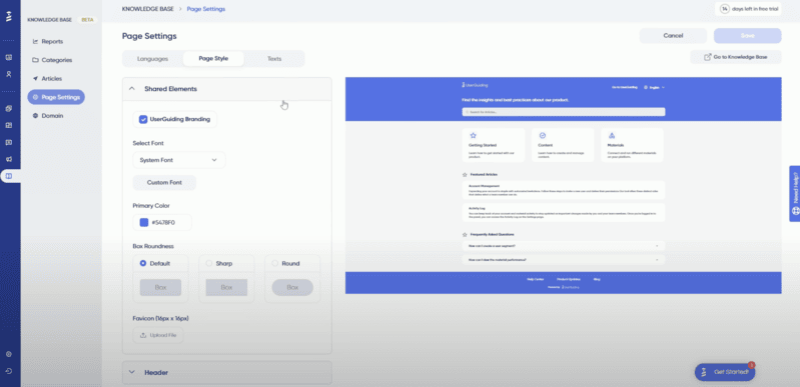
With UserGuiding, you get a no-code editor and ready-to-use templates that let anyone (from product managers to support reps) create helpful, organized articles in minutes. It’s built to keep pace with your product, not slow it down.
Search and navigation
If users can’t find what they’re looking for, they’ll either give up or send you a ticket.
Search is the front door to your knowledge base. It needs to be fast, forgiving, and smart. Add intuitive navigation and logical structure, and you’ve suddenly made self-service actually usable.
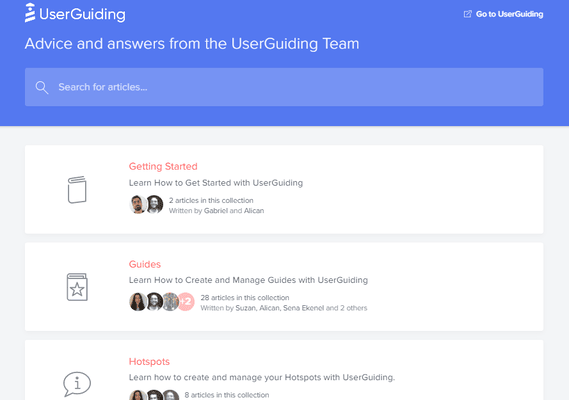
UserGuiding’s knowledge base handles this effortlessly. Articles are automatically categorized, search is built in, and users can find what they need without leaving your product.
Customer experience enhancements
Just because it’s “support content” doesn’t mean it has to be boring.
Great knowledge bases feel like a natural part of the product experience. Personalized, contextual, on-brand. That kind of UX makes users feel supported and not shuffled off to some forgotten help site.
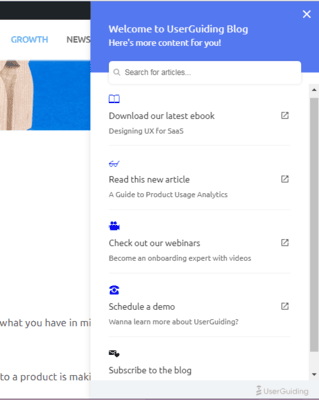
UserGuiding makes it seamless. Embed interactive guides right inside your app, customize your resource center to match your product’s look and feel, and use the content library and best practices to turn basic help docs into truly useful experiences.
Analytics and optimization
Guessing what your users need? That’s a gamble. 🎲
You should know what users are reading, what they’re skipping, and where they’re getting stuck. Without that data, your content strategy is just educated guesswork.
UserGuiding gives you real insights into how your knowledge base performs. You can see what’s working, what needs fixing, and where to focus your energy for maximum impact.

Integrations and AI assistance
Your knowledge base shouldn’t live in isolation.
It should work with the rest of your support and product stack (chat tools, CRMs, ticketing systems) and evolve alongside your workflows. Bonus points if it helps you create content, not just store it.
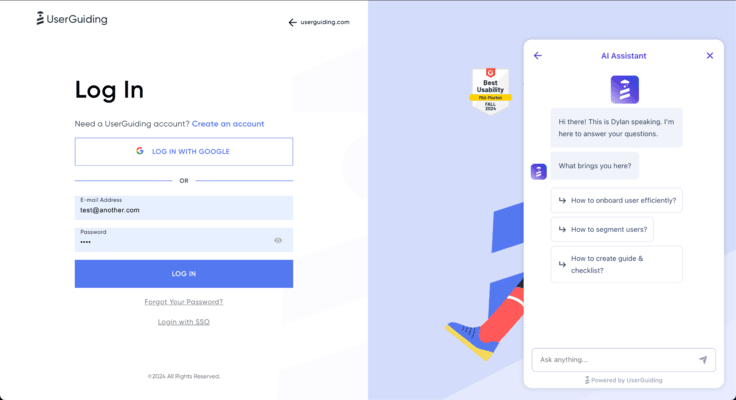
That’s where UserGuiding’s integrations and AI chatbot, Dylan, come in.
Dylan helps you draft content, answer common questions, and keep your base up-to-date without extra manual effort. Meanwhile, native integrations make it easy to sync across tools you’re already using.
15 best SaaS knowledge base tools
1- UserGuiding
UserGuiding is a product adoption platform that helps you create personalized user onboarding experiences. However, there’s more to it.
UserGuiding is also best known as free knowledge base software and can be used to increase user engagement and activation.
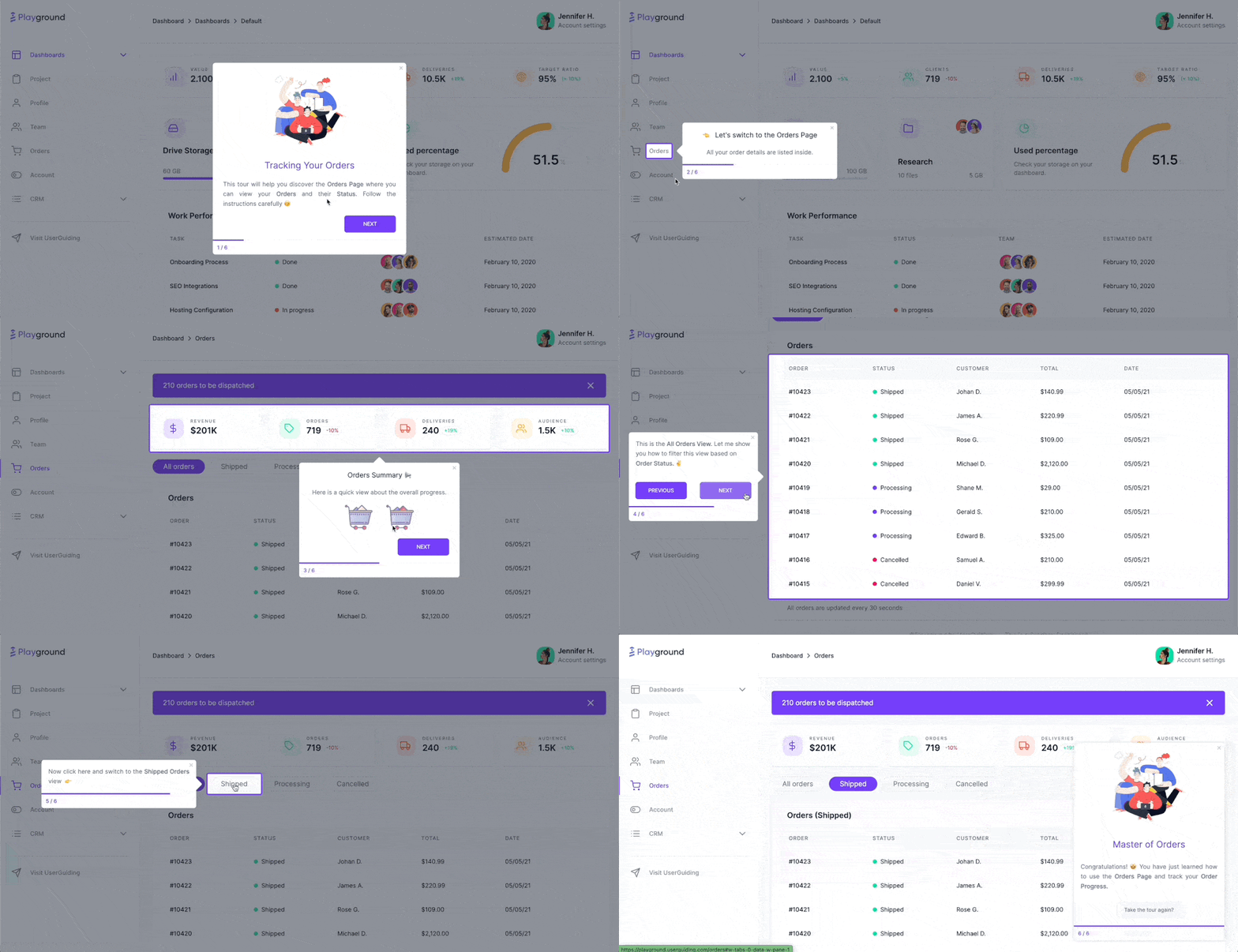
Here’s what you get with this feature:
- Lightweight, no-code knowledge base widget
- Seamless in-app access to help articles
- Integration with product tours, tooltips, and onboarding flows
- Real-time analytics on article views and search performance
- Fully brandable and customizable resource center
What makes UserGuiding stand out, then?
Well, UserGuiding lets you embed support directly into the product interface, which reduces friction and helps users find answers without ever leaving the app. It has a modern, UX-friendly take on knowledge sharing that fits right into a SaaS onboarding strategy.
However, keep in mind that UserGuiding is better suited for teams prioritizing in-app support over deep documentation workflows, which means that features like robust categorization or advanced publishing controls might be limited.
Pricing
UserGuiding has a 14-day free trial option.
There are three different plans for different business sizes and needs:
- Starter: Starting from $174/mo. This plan offers all adoption features and an AI assistant.
- Growth: Starting from $349/mo. Includes everything in Starter, plus A/B testing and goal tracking.
- Enterprise: Custom quote. Includes everything in Growth, plus compliance (SOC2 & GDPR) and personalized coaching.
2- Document360
Document360 is best for building structured, scalable knowledge bases for internal teams or end-users. As an AI-powered documentation solution, it offers many key features, including:
- Markdown-based editor with version control
- Category manager with deep hierarchy support
- AI-powered search and article suggestions
- Private and public knowledge base options
- Integrations with tools like Slack, Intercom, Microsoft Teams, and Zendesk

Document360 is purpose-built for documentation at scale. Its clean interface, granular access controls, and powerful organization tools make it a strong fit for growing SaaS companies that need both internal and external documentation hubs.
However, while rich in features, the UI can feel complex for smaller teams or non-technical users just looking for a simple help center as users often report bugs and editing difficulties.
Pricing
Document360 does not list dollar amounts on its website and you need to get custom quotes for each plan. It offers three different pricing plans:
- Professional
- Business
- Enterprise
3- Zendesk
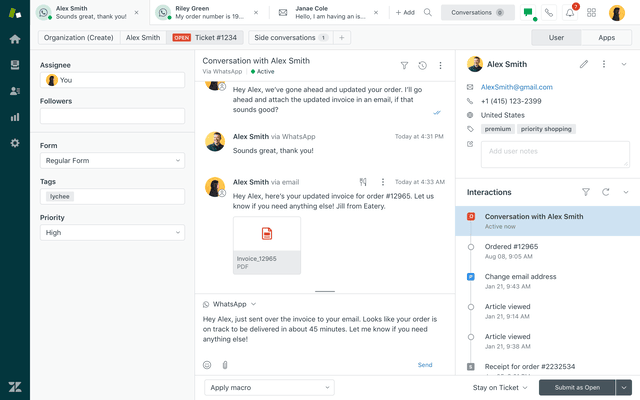
Zendesk is a customer service solution best suited for those looking for a unified customer support and knowledge base in one platform.
With Zendesk’s help center, you can empower customers to find answers themselves. It supports easy authoring, fast updates, team collaboration, and smooth website embedding. And the best part? These are all inside the Zendesk suite.
Just keep in mind that the knowledge base is part of Zendesk for service. It’s best suited if you’re already using (or planning to use) the whole ecosystem.
Moreover, you might find it limited in terms of customization if you don’t have developer resources, and pricing can become steep as your team grows.
Pricing
- Suite Team: $55/mo per agent, billed annually.
- Suite Growth: $89/mo per agent, billed annually.
- Suite Professional: $115/mo per agent, billed annually.
- Suite Enterprise: Custom price.
4- Helpjuice
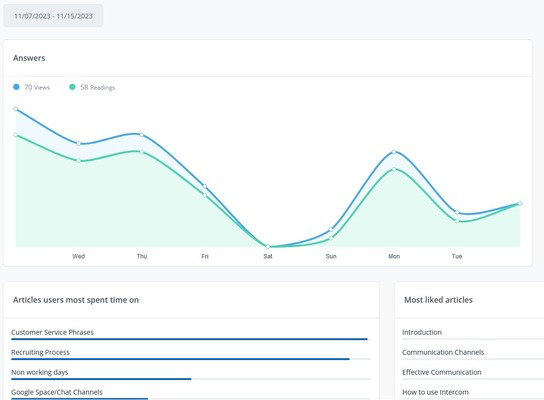
Helpjuice is all about getting your internal or external knowledge base up and running without the usual tech headaches. You get a clean, intuitive editor, powerful search, and detailed analytics, plus unlimited users if needed.
Some of its other capabilities are:
- Detailed analytics on article performance and searches
- White-labeling support for brand consistency
- Powerful search with instant suggestions
It’s ideal if you want to create a customer-facing help center or an internal wiki, and look good doing it. But, note that it offers limited integrations compared to competitors and lacks advanced workflow or approval features.
Pricing
HelpJuice has one plan, and the pricing depends on the number of users you have:
- Up to 16 users: $200/mo.
- Up to 60 users: $289/mo.
- Unlimited users: $659/mo.
5- Notion
Notion isn’t just a knowledge base, it’s a Swiss army knife for docs, wikis, projects, and more. It’s sleek, endlessly flexible, and perfect if you want to blend documentation with team planning and project tracking in one place.
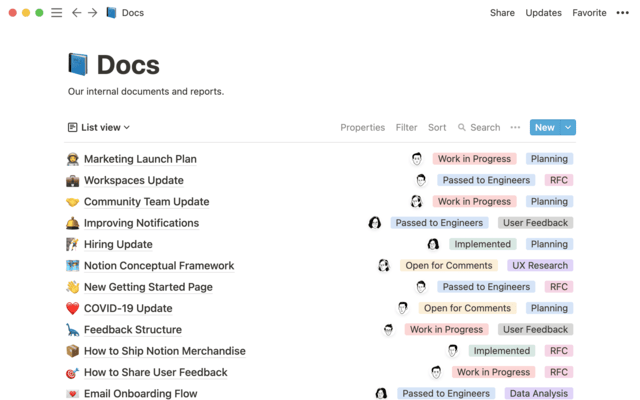
That said, Notion is better for internal knowledge sharing. If you need a large public help center, you might find its search and structure a bit limited.
Pricing
- Free: Free for personal use.
- Plus: $10/mo per member, billed annually.
- Business: $20/mo per member, billed annually.
- Enterprise: Custom pricing.
6- Confluence
Confluence is the favorite child of teams already using Jira and other Atlassian tools. It’s perfect for creating structured internal docs and team wikis. You get page trees, advanced permissions, and seamless integration with your existing workflows.
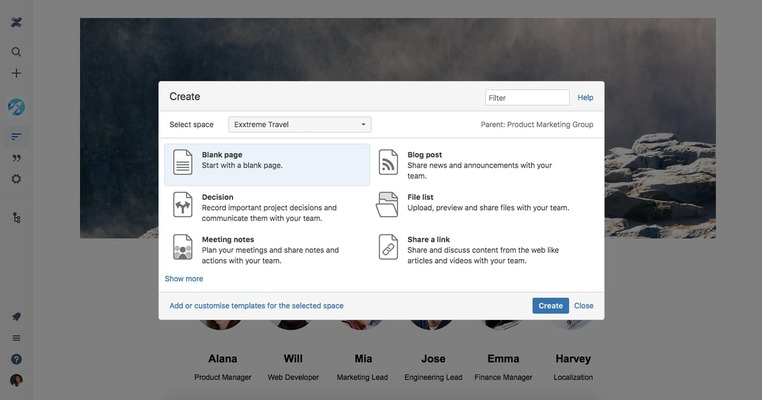
However, it can feel heavy if all you need is a simple, customer-facing help center that doesn’t rely on Atlassian products. Also, the UI isn’t as intuitive for new users.
Pricing
- Free: Free up to 10 users.
- Standard: $15,500/year.
- Premium: $29,175/year.
- Enterprise: Custom pricing.
⚠️ Keep in mind that the prices listed are for up to 300 users.
7- Guru
Guru is all about quick, verified answers at your fingertips to share across fast-moving teams. Its key features include:
- Browser extension for instant access anywhere
- Knowledge verification workflows with assigned experts
- AI-suggested cards and usage analytics
- Slack and Teams integrations for easy push-pull knowledge
- Strong emphasis on internal enablement
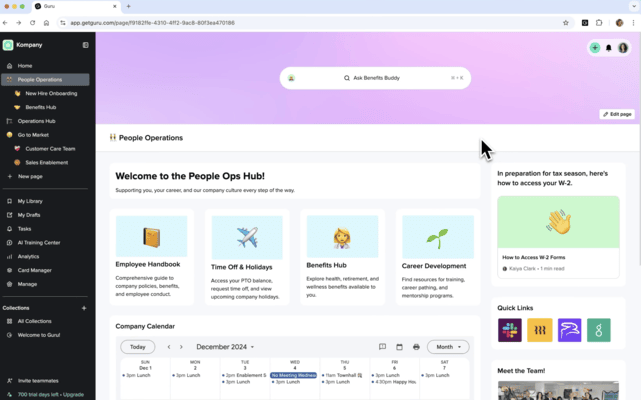
Guru’s real-time, in-workflow approach ensures knowledge is both up-to-date and easily consumable, making it ideal for sales, support, and CX teams. However, if you’re after deep technical documentation or public articles, Guru might not be your go-to.
Pricing
- Free trial: 30-days of full free access to the entire platform.
- All-in-one: $15/mo per user, billed annually.
- Enterprise: Custom pricing.
8- Nuclino
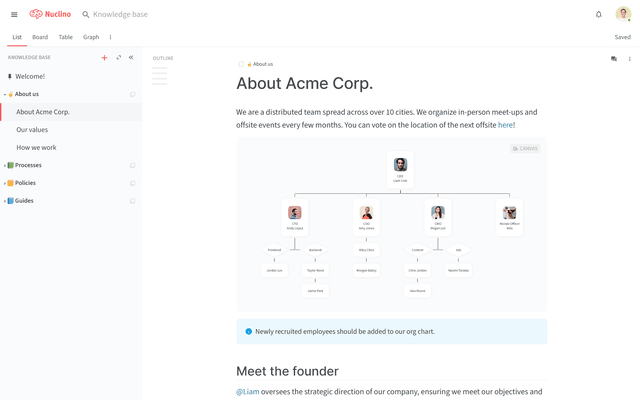
Nuclino keeps things light and ultra-fast. Perfect for small teams that want a simple, no-clutter internal wiki. Its visual graph and minimalist editor make organizing and linking docs super intuitive.
But for complex public help centers or in-depth analytics, Nuclino might feel too basic.
Pricing
- Free: Free up to 50 items with no user limit.
- Starter: $6/mo per user, billed annually.
- Business: $10/mo per user, billed annually.
9- Bloomfire
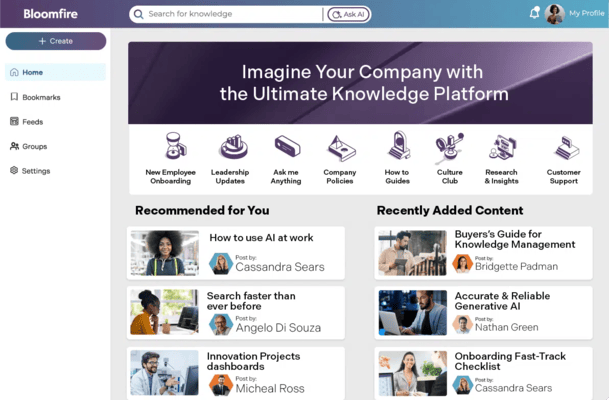
Bloomfire makes all your company knowledge searchable and shareable: videos, documents, slide decks, you name it. Its AI-powered search and friendly interface help teams collaborate and break silos effortlessly.
It’s designed more for internal knowledge sharing, so it may not be the best fit if you’re focused purely on customized customer-facing documentation. It can also be expensive for small organizations.
Pricing
All plans are custom-priced. Bloomfire offers three different plans:
- Single team access
- Department-wide access
- Company-wide access
10- Zoho
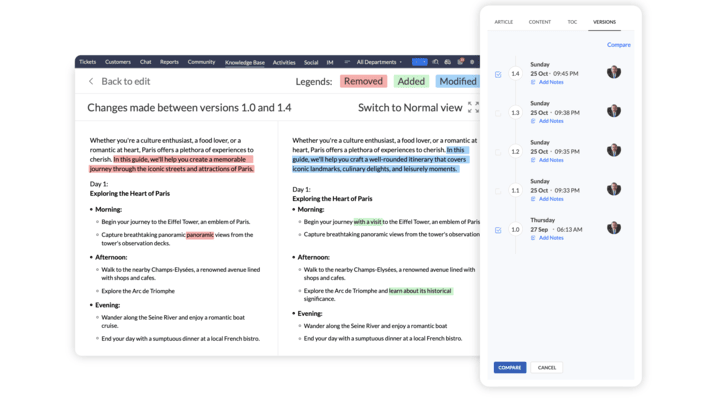
Zoho’s knowledge base is a natural extension of its help desk suite. It’s great for small and mid-sized teams who already live in the Zoho ecosystem and want an easy way to add self-service to their support mix.
⚠️ Just know: heavy customization and advanced design options are a bit limited here.
Pricing
- Express: $7/mo per user, billed annually.
- Standard: $14/mo per user, billed annually.
- Professional: $23/mo per user, billed annually.
- Enterprise: $40/mo per user, billed annually.
11- ProProfs
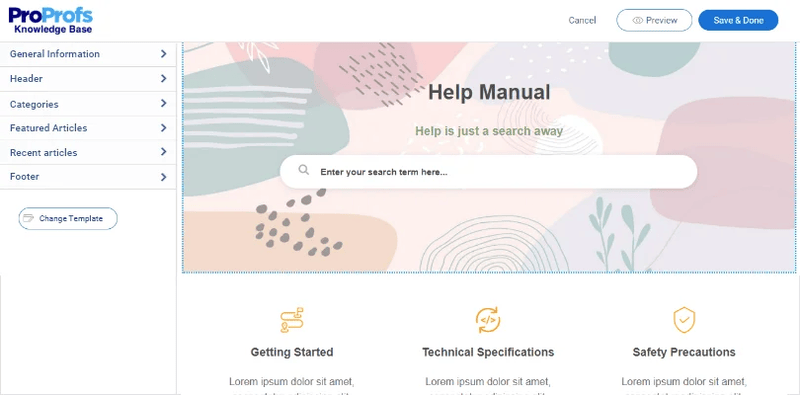
ProProfs makes launching a knowledge base refreshingly simple. There’s no-coding and no fuss. It’s great for teams that want to get a public help center or internal docs up quickly and start helping users right away.
But if you need deeply layered documentation or sophisticated workflows, you might outgrow it fast.
Pricing
- Free: Free up to one author and 25 pages.
- Essentials: $49/mo per author, billed annually.
- Business: $79/mo per author, billed annually.
- Enterprise: $199.99/mo per author, billed annually only.
12- Help Scout
Help Scout’s knowledge base, aka Docs, is designed to work hand in hand with its email and live chat support. You can embed articles right in chat, keep customers self-sufficient, and reduce ticket volume without breaking a sweat.
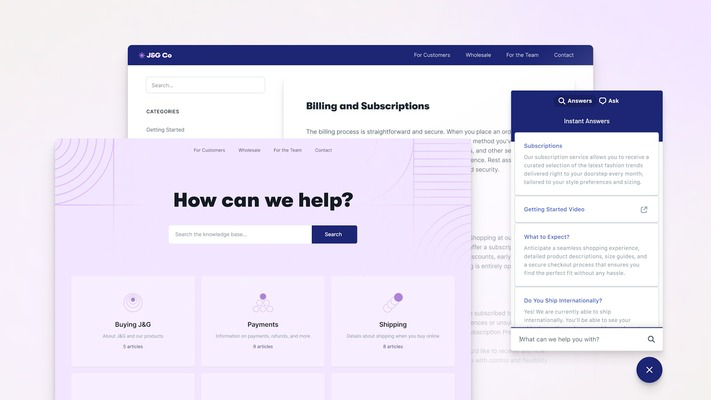
However, Docs is more basic compared to some specialized documentation platforms, so it’s best if you need a simple, integrated approach.
Help Scout’s other features include:
- Beacon widget for embedded help and live chat
- Docs knowledge base fully integrated with support inbox
- Reporting and customer satisfaction tracking
- Shared inbox and collision detection
- Extensive integrations (HubSpot, Salesforce, etc.)
Pricing
- Free: Free up to 100 contacts per month.
- Standard: $385/mo.
- Plus: $475/mo.
⚠️ Keep in mind that the prices listed here are based on 1,000 contacts helped. The dollar amount will change based on the number of active monthly contacts helped.
13- Knowmax
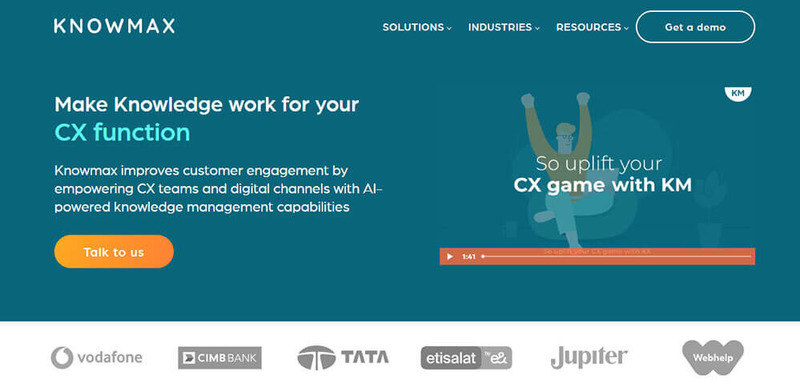
Knowmax is made for teams that love workflows and guided decision trees. It helps you build interactive, step-by-step guides so your support agents (or even customers) can resolve issues faster and more consistently.
It’s not your typical article-heavy knowledge base. It’s all about process-driven knowledge delivery, which is both an advantage and a disadvantage. It is less suited for traditional article-based knowledge bases or content-heavy technical documentation.
Pricing
Knowmax is not exactly transparent about its pricing plans. However, online sources report that pricing starts from $14.99/mo per user.
14- HelpCrunch
HelpCrunch is like your one-stop SaaS shop for customer messaging and self-service. Alongside live chat, email, and pop-ups, it gives you a clean, easy-to-use knowledge base to reduce repetitive questions.

But keep in mind that its knowledge base is simpler than what you’d get from a standalone documentation-focused platform.
Pricing
- Basic: $12/mo per member, billed annually.
- Pro: $20/mo per member, billed annually.
- Unlimited: $495/mo, billed annually. Unlimited members.
15- Hudu
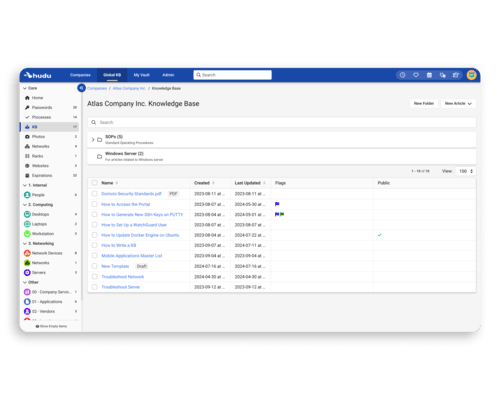
Hudu is a game changer for IT teams and managed service providers. It offers client-specific portals, password management, and SOP templates. To put it short, everything you need to centralize sensitive knowledge securely.
If you’re in IT, you’ll love it. If you’re after a public help center for SaaS customers, not so much.
Pricing
- One Easy Price: $27/mo per user, billed annually.
Free knowledge base software you should try
There are a few popular options if you’re looking for a knowledge base tool that’s either included in a broader suite or designed to get you started quickly.
Here’s a quick look at five well-known picks and what they offer:
- UserGuiding: Offers an in-app knowledge base you can easily integrate with product tours, checklists, and resource centers. Perfect for SaaS teams focused on onboarding and self-service help.
- Zoho: Includes a built-in knowledge base to reduce tickets and improve customer self-service with advanced features like multi-brand support in higher tiers.
- Helpjuice: Specializes in powerful, easy-to-use knowledge bases with strong search and customization.
- Help Scout: A simple, clean knowledge base tool integrated with their shared inbox.
- HubSpot: Comes with a knowledge base feature to turn common support questions into searchable articles.
If you’re just getting started, these options can help you launch fast. But if you need advanced structure or deeper analytics, consider dedicated knowledge base platforms built specifically for scale.
Comparison table of knowledge base tool
Conclusion
A knowledge base isn’t just a nice-to-have anymore; it’s essential. In fact, 81% of customers try to solve problems themselves before contacting a live representative. That means if your help content isn’t accessible, organized, or easy to use, you’re not just missing an opportunity. You’re increasing your support load.
So, how do you find the right tool?
Here’s a quick way to narrow it down:
- Solo founders or early-stage teams → Go for simple, fast-to-launch tools like Notion or Nuclino. They’re easy to set up, flexible, and ideal for internal documentation or lightweight help centers.
- Scaling SaaS businesses → You’ll want something that grows with you. Tools like Document360 and UserGuiding offer structured knowledge bases with advanced organization, in-app widgets, and user-friendly interfaces.
- Enterprise-level support teams → Prioritize scalability, permissions, and analytics. Zendesk and Helpjuice offer powerful, customizable knowledge bases that can handle high volumes of content and users.
And don’t stop at just a help center. Combining your knowledge base with onboarding flows (like those in UserGuiding) or live chat tools (like HelpCrunch or Help Scout) can dramatically boost customer satisfaction and reduce friction.
The right tool makes your knowledge easy to find, easy to use, and even easier to scale.
Frequently Asked Questions
What are the best free knowledge base tools for early-stage SaaS startups in 2025?
For early-stage SaaS startups on a tight budget, the best free knowledge base tools in 2025 include:
- Notion – Great for building lightweight internal and external docs with collaboration features.
- Nuclino – Clean interface and real-time collaboration for small teams.
- Zoho Desk (Free Tier) – Offers basic help center functionality for startups managing support tickets.
- Confluence (Free Plan) – Ideal for technical teams needing structured documentation.
How do you choose a SaaS knowledge base tool with in-app support and analytics?
To choose a SaaS knowledge base tool with in-app support and analytics, prioritize:
- In-app widgets (for context-based help)
- Engagement analytics (track article views, search terms, drop-offs)
- Ease of content management (drafts, version history)
- Integration with support platforms
Top tools that meet these criteria:
- UserGuiding – Combines knowledge base + onboarding flows with built-in analytics
- Help Scout – Includes “Beacon” for in-app support + Docs performance insights
- Document360 – Advanced analytics dashboard + embeddable widgets
What are the top-rated knowledge base tools that integrate with Intercom, Zendesk, or HubSpot?
If you’re already using Intercom, Zendesk, or HubSpot, here are the top-rated tools with native or seamless integrations:
- Guru – Easily integrates with Intercom and Slack, great for internal knowledge
- Document360 – Offers integrations with Intercom, Zendesk, and HubSpot CRM
- Helpjuice – Connects with Intercom and Zendesk, focused on customer-facing KBs
- Zoho Desk – Native integration with HubSpot for support and sales sync
- HelpCrunch – Combines live chat and help center with Intercom-style UX
Based on pricing, features, and customer satisfaction scores, what are the top 5 SaaS knowledge base software?
Here are the top 5 SaaS knowledge base tools in 2025, ranked by affordability, core features, and G2/Capterra ratings:
- Document360 – Best for scale; advanced features, AI search, granular control
- UserGuiding – Combines KB with onboarding; ideal for product-led teams
- Helpjuice – Powerful search, great for internal and customer-facing use
- Help Scout – Clean UI, in-app help widget, great support
- Guru – Internal knowledge sharing with real-time Slack and Chrome extensions
Which free knowledge base tools offer AI-powered search and article suggestions?
Few free tools offer AI features, but these stand out in 2025:
- Document360 (Free Trial) – AI-powered search and article recommendations
- Notion AI (Free tier limited) – Use AI to generate, summarize, and rewrite KB content
- Zoho Desk – Zia AI helps with article tagging and smart suggestions (limited in free tier)
- Guru (Free plan for up to 3 users) – AI-backed suggestions inside Slack/Chrome
Most truly free AI-enabled KBs are limited. For advanced AI search and insights, paid plans are typically required.

.png)